
استمتع بـUnlimited مع Magzter GOLD
احصل على وصول غير محدود إلى أكثر من 9000 مجلة وصحيفة وقصة مميزة مقابل
يحاول ذهب - حر
GST Rate Cuts: Economic and Political Dimensions
October 01 - 31, 2025
|BUSINESS ECONOMICS
On August 15, 2025, in his Independence Day address, Prime Minister Narendra Modi announced sweeping reforms in the Goods and Services Tax (GST) structure to be implemented by Diwali.
He stressed the need to simplify GST and ease the burden on the common citizen. Following this, the GST Council, in its meetings on September 3 and 4, 2025, decided to reduce GST rates and rationalize slabs. The stated aim was to lower the prices of essential goods and provide relief to households.
The Council reduced the number of slabs from five (0%, 5%, 12%, 18%, and 28%) to three (0%, 5%, and 18%). However, the persistence of a 3% slab on gold and the creation of a 40% slab on luxury and sin goods (such as tobacco and pan masala) means the effective structure still contains five slabs. In practice, therefore, the framework has not changed as drastically as announced. That said, GST on daily-use items—soap, shampoo, toothpaste, snacks, chocolates, dairy products—was slashed from 12% or 18% to 5% or even zero. Taxes on medicines, medical equipment, automobiles, and health and life insurance were also reduced or waived.
On September 21, 2025, Modi addressed the nation again, declaring September 22-29 as “Bachat Diwas” to encourage savings and promote the benefits of the GST cuts. These changes took effect on September 22. Supporters and government representatives framed the move as a counter to U.S. President Donald Trump’s 50% tariff on Indian imports. Analysts at Citi Group, Nomura, and Morgan Stanley estimated U.S. tariffs could shave 0.6%-1.1% off India’s GDP. GST cuts, they argued, could offset this by boosting domestic demand. Indian financial institutions have projected that GST 2.0 could add 0.2%-0.7% to GDP growth.
Yet the question remains: why would the government reduce GST, a cornerstone of its revenue? The Union Budget 2025 documents reveal that GST contributed 27.5% of central tax revenue in 2024-25 and is projected to remain at that level in 2025-26. Collections in 2024-25 stood at ₹10.61 lakh crore, expected to rise to ₹11.78 lakh crore in 2025-26. This makes the reform a gamble with substantial fiscal consequences.
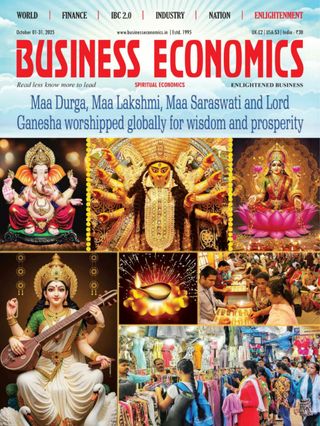

هذه القصة من طبعة October 01 - 31, 2025 من BUSINESS ECONOMICS.
اشترك في Magzter GOLD للوصول إلى آلاف القصص المتميزة المنسقة، وأكثر من 9000 مجلة وصحيفة.
هل أنت مشترك بالفعل؟ تسجيل الدخول
المزيد من القصص من BUSINESS ECONOMICS

BUSINESS ECONOMICS
Tata Power introduces EZ Home Automation Solutions in Kolkata
Designed to make everyday life more comfortable and secure, Tata Power introduced its Tata Power EZ Home Automation Solutions in Kolkata.

1 min
February 01 - 28, 2026

BUSINESS ECONOMICS
Economic Survey 2025–26
Every year, the Economic Survey is presented in Parliament two days before the Union Budget.
3 mins
February 01 - 28, 2026

BUSINESS ECONOMICS
Navigating the soul's ultimate intelligence
In recent years, psychologists and thinkers have introduced the concept of Spiritual Intelligence (SI) to describe what makes a human being whole, integrated, and profoundly creative.
3 mins
February 01 - 28, 2026

BUSINESS ECONOMICS
Where Bengal meets Rajasthan in heritage conservation
The government of Rajasthan organized a significant heritage preservation initiative as part of the NDTV Conclave - 'Rising Rajasthan Vikas Bhi, Virasat Bhi', held on 24th December at Mandawa Castle, Fort Mandawa, Rajasthan.
1 min
February 01 - 28, 2026

BUSINESS ECONOMICS
Structural glitches trouble Indian economy
India's economy is often described as one of the fastest-growing in the world.
2 mins
February 01 - 28, 2026

BUSINESS ECONOMICS
Tredence sets the stage for Eastern India's AI future with new center in Kolkata
Tredence announced the inauguration of its new office in Kolkata, in the presence of Babul Supriyo, Minister of Information Technology and Electronics, West Bengal.
1 min
February 01 - 28, 2026

BUSINESS ECONOMICS
Educator, Author, and Thought Leader on Consciousness, Education, and Governance
Devesh Gupta works at the intersection of consciousness, education, and public systems.
5 mins
February 01 - 28, 2026

BUSINESS ECONOMICS
Beyond GDP numbers- recalibrating prosperity for 2026
Why growth alone no longer tells the full story
2 mins
February 01 - 28, 2026

BUSINESS ECONOMICS
World's greed for Rare Earth: US steps into Greenland, Venezuela & Ukraine
Attempts to grab Greenland, Ukraine & Venezuela are examples of modern-day colonialism.
3 mins
February 01 - 28, 2026

BUSINESS ECONOMICS
TCG CREST to expand globally with academic hubs in the UK, Japan, and the US
TCG CREST (Deemed University) announced a significant expansion roadmap, outlining its plans to establish academic hubs in the UK, Japan, and the US as part of a broader strategy to deepen global research collaboration and cross-sector engagement.
1 min
February 01 - 28, 2026
Listen
Translate
Change font size