يحاول ذهب - حر
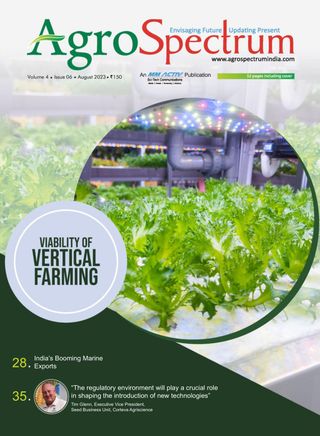
VIABILITY of Vertical Farming
AgroSpectrum India August 2023
|AgroSpectrum
The past decade has witnessed an increased dependence on technology and tech-enabled agriculture. The government, too, has been actively promoting the adoption of agri innovations, including AI, ML and monitoring of crops via satellite. With a focus on increasing productivity and providing precise data to cultivators for informed planning, technology has made significant inroads. Vertical farming is one such technological marvel gaining traction worldwide. It is particularly popular in smaller countries facing land constraints and water scarcity. Countries such as Singapore, the Middle East, the UK, and Japan have embraced vertical farming, revolutionising their agriculture. However, in India, while vertical farming has gained some momentum, its adoption remains limited to urban areas, as traditional farming is still the more convenient and profitable choice for rural cultivators. Yet, there is a new crop of startups that are keen to make vertical farming widely accepted by farmers and consumers alike. Let’s explore this further.

Around the world, sustainability has become a driving force across industries, including agriculture. Many countries are shifting towards farming solutions that demand less land, water and pesticides, with a focus on organic practices. Of course, these countries, either aren’t blessed with favourable climatic conditions, adequate and reliable rain, rich soil, and in some cases, a vast expanse of arable land. Vertical farming is one such solution empowering cultivators to grow produce with minimal land and water usage, and almost no pesticides or insecticides. Despite its promising prospects, vertical farming still has a long way to go to match the scale of traditional farming. The industry is presently valued at close to $200 million, with estimates suggesting it will double in size over the next five years.
The demand for eco-friendly, regionally produced, and natural products is witnessing a significant rise, a trend mirrored in the commercial feasibility of vertical farms. Technological advancements have driven down production costs, making vertical farms a viable alternative to traditional farming methods that heavily rely on pesticides and fertilisers. In the US alone, the number of active vertical farms exceeds 2,000. Buildings or shipping containers can house these farms, achieving greater yields than conventional outdoor farming, using 70-95 per cent less water.
Vertical farming entails growing crops vertically, optimising yield from the same land area by stacking crops. These stacked layers are often installed in structures that are not naturally suitable for farming, such as skyscrapers, warehouses, shipping containers, greenhouses, and even indoor facilities.

هذه القصة من طبعة AgroSpectrum India August 2023 من AgroSpectrum.
اشترك في Magzter GOLD للوصول إلى آلاف القصص المتميزة المنسقة، وأكثر من 9000 مجلة وصحيفة.
هل أنت مشترك بالفعل؟ تسجيل الدخول
المزيد من القصص من AgroSpectrum

AgroSpectrum
How AI Is Rewiring Decision-Making Across Indian Agriculture
For decades, Indian agriculture has lived with uncertainty as a structural condition—of weather, markets, prices, and outcomes. Decisions were shaped as much by intuition as by information, and risk was absorbed almost entirely by those closest to the soil. That equilibrium is now being quietly but decisively rewritten. Artificial intelligence, once confined to pilots and proof-of-concepts, has crossed a threshold. It is no longer an experiment in agriculture—it is becoming infrastructure.

7 mins
AgroSpectrum India Feb 2026
AgroSpectrum
Rewriting the Rules for Farm Inputs
India’s agricultural reform agenda is entering a crucial moment. After decades of relying on outdated, paper-based regulation, the government is now signalling a decisive shift towards technology-driven transparency and accountability.
2 mins
AgroSpectrum India Feb 2026

AgroSpectrum
"India should move toward productivity-linked livestock insurance–but only through a phased, data-anchored evolution"
As livestock becomes an increasingly critical pillar of rural incomes amid climate and market uncertainties, the lack of effective risk protection remains a major gap in India’s agricultural policy landscape. In this exclusive AgroSpectrum interview, Ritesh Chauhan, Secretary of Animal Husbandry, Government of Himachal Pradesh, explains why advances in digital identification, veterinary networks, cooperatives, and fintech now make a scalable livestock insurance framework both viable and essential. Drawing from Himachal Pradesh’s on-ground experience, he shares practical insights on building trust, improving claim settlement, and strengthening insurer participation. Edited excerpts:
7 mins
AgroSpectrum India Feb 2026

AgroSpectrum
Why 2026 Could Be a Turning Point for India's Aquaculture Sector
India's aquaculture sector is entering a decisive phase of transformation, driven by rising domestic demand, strong export growth and sustained policy support. As the world's second-largest aquaculture producer, contributing nearly 8 per cent of global fish output, India has achieved remarkable gains in production, productivity and economic value. However, escalating input costs, climate stress and disease risks are testing the limits of conventional practices. The next stage of growth will depend on adopting sustainable, resilient approaches that improve feed efficiency, diversify farmed species and strengthen climate adaptation across production systems.
4 mins
AgroSpectrum India Feb 2026

AgroSpectrum
How Integrated Sugarcane-based Industries are Driving Sustainable Growth, Ethanol Output & Rural Transformation
Sugarcane is called the \"green gold\" of agriculture, and indeed, this crop has historically been vital to the prosperity of rural communities. This versatile crop, esteemed for its production of sugar, jaggery, and khansari, is now at the forefront of a transformative movement. In fact, this transformation is leveraging the crop's immense potential. Utilising its agricultural strengths, India, recognised as the second-largest producer of sugarcane globally, is addressing multiple critical issues of our time, including climate change, energy security, and rural development. The area designated for sugarcane cultivation has grown to over 5.4 million hectares, with yearly outputs exceeding 400 million metric tonnes. As a result, sugarcane has evolved beyond being just a crop; it has emerged as a catalyst for change.
4 mins
AgroSpectrum India Feb 2026
AgroSpectrum
AgroSpectrum to host 2nd edition of Technovate 2026 on March 12-13 in Vashi
After the successful completion of its first edition, AgroSpectrum is again ready for its second edition of AgroSpectrum Technovate 2026 on 12 and 13th March 2026 with the theme \"Transforming Agriculture with Innovation and Technology\" at CIDCO Exhibition & Convention Centre in Vashi, Navi Mumbai.
1 min
AgroSpectrum India Feb 2026

AgroSpectrum
Boosting turmeric supply chain initiatives
India leads the global turmeric supply chain, being the largest producer, consumer and exporter of turmeric. The major turmeric export markets for the country are Bangladesh, the UAE, and the US. It accounts for over 62 per cent of the market, with its supply chain spanning cultivation in key states like Andhra Pradesh, Telangana, and Bihar. This yellow spice from the Curcuma longa plant serves as both a culinary staple and a traditional remedy with anti-inflammatory properties. Though India is one of the largest producers of turmeric, the country imports a substantial amount from other countries. Erratic climatic conditions, value addition, product innovation and product development appear weaker, leading to a shortfall in output. Proper strategies should be in place to boost turmeric production and the supply chain. Let's dig deeper.
5 mins
AgroSpectrum India Feb 2026

AgroSpectrum
"Our technology bridges scientific precision with farmer knowledge, creating a system that is scalable, future-ready, and capable of transforming agriculture at scale"
As climate volatility reshapes Indian agriculture, digital intelligence is emerging as a critical resilience tool. In this exclusive AgroSpectrum interview, Ajay Shelke of WOTR explains how FarmPrecise applies AI and hyperlocal weather data to deliver field-level advisories and evolve into a farmer-centric digital operating system for climate-vulnerable regions. Edited experts;
4 mins
AgroSpectrum India Feb 2026

AgroSpectrum
How AI is Reimagining Agriculture in India
Agriculture remains central to India's economy, contributing to GDP and employing nearly half the workforce, but it faces challenges such as fragmented landholdings, monsoon dependence and resource inefficiencies. Technology, particularly Artificial Intelligence (AI), is emerging as a key enabler alongside policy support. AI-driven tools like satellite imagery, Internet of Things (IoT) sensors and data analytics are strengthening precision farming through yield forecasting, risk mapping and micro-climate prediction. Focusing on the current Rabi season, this analysis draws on pilot initiatives to examine how AI is improving efficiency and profitability while addressing accessibility challenges for small and marginal farmers.
4 mins
AgroSpectrum India Feb 2026

AgroSpectrum
“Policymakers can make climate-smart farming viable by creating incentives that are practical and profitable.”
UPL, with its presence in over 140 countries, has recently launched its global campaign #AFarmerCan. Jai Shroff, Chairman and Group CEO, UPL Group, in an interaction with AgroSpectrum, elaborates on how UPL is advocating stronger financial and institutional mechanisms that reward sustainable practices and build long-term resilience. Edited excerpts;
4 mins
AgroSpectrum India Feb 2026
Translate
Change font size