يحاول ذهب - حر
Annie Maunder
April 2022
|BBC Sky at Night Magazine
Ezzy Pearson celebrates the achievements of the early 20th century's great solar scientist

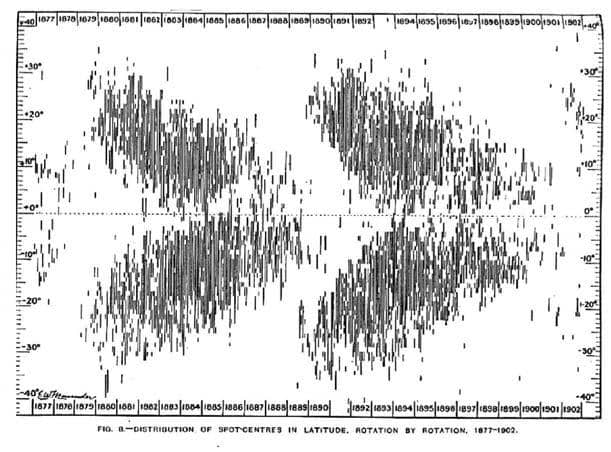
This March, English Heritage commemorated the lives of two great solar scientists, Annie Maunder and her husband Walter, by placing a blue plaque on their former home on Tyrwhitt Road in Lewisham, south London. The pair spent decades observing and studying the Sun, even giving their name to a period of low solar activity at the end of the 17th century now known as the Maunder Minimum.
English Heritage's blue plaque scheme, which began in 1866, honours notable people with distinctive circular signs on the buildings they lived and worked in. Twelve new plaques are erected annually, each one considered by a panel of historians, artists, scientists and writers.
Howard Spencer, English Heritage's Senior Historian, explains why the Maunders have been selected. “As well as their important work on sunspots, solar photography and the debunking of the canals-on-Mars myth, the Maunders were also active in promoting amateur astronomy, he says.
Annie Maunder was born Annie Russell in County Tyrone, Ireland, in 1868. She excelled at school and earned a place at Girton College, Cambridge. Despite being her college's top mathematician, restrictions of the day meant she was unable to receive a degree: her achievements occurred during a time when being a woman meant she was barred from academic recognition, and much of professional astronomy.
In 1891, she took a position at the Royal Observatory Greenwich as a 'lady computer', mathematically calculating the positions and brightnesses of stars by hand. In the late 19th century, this tedious, low-paid role was performed by university-educated women who were denied the higher status jobs of their male counterparts.

هذه القصة من طبعة April 2022 من BBC Sky at Night Magazine.
اشترك في Magzter GOLD للوصول إلى آلاف القصص المتميزة المنسقة، وأكثر من 9000 مجلة وصحيفة.
هل أنت مشترك بالفعل؟ تسجيل الدخول
المزيد من القصص من BBC Sky at Night Magazine
BBC Sky at Night Magazine
The Giant Leap: Why Space is the Next Frontier in the Evolution of Life
“Earth is the cradle of humanity, but one cannot live in the cradle forever,” wrote Konstantin Tsiolkovsky in 1911.

1 mins
February 2026
BBC Sky at Night Magazine
Tele Vue Nagler Type-7 series eyepieces
These premium optics were inspired by Apollo - and deliver a giant leap to your views
4 mins
February 2026
BBC Sky at Night Magazine
Once Upon a Time in Space
While the Space Race of the Cold War years was ultimately a geopolitical contest between the USA and the Soviet Union, the rivalry sparked rapid innovation and inspired multiple generations to look skyward.
1 mins
February 2026
BBC Sky at Night Magazine
The Multiverse: When One Universe Isn't Enough
The concept of a 'multiverse' – the idea that our Universe may be just one of many – is widespread in science fiction and a common thread of online discussions.
1 mins
February 2026

BBC Sky at Night Magazine
Q&A WITH A GAMMA RAY SPECIALIST
In 2025, astronomers detected a blast from space that lasted seven hours. Now they're uncovering the strange processes behind the exceptional outburst
3 mins
February 2026

BBC Sky at Night Magazine
Astronomy Photographer of the Year
The world-leading astrophotography competition returns. Could your image take the top prize of £10,000?
2 mins
February 2026
BBC Sky at Night Magazine
MOONWATCH
February's top lunar feature to observe
2 mins
February 2026

BBC Sky at Night Magazine
NOVAStar Scarlet A62Q 62mm f/8.4 quadruplet achromatic refractor
Well-built and capable, this beginner scope punches well above its bargain price
4 mins
February 2026
BBC Sky at Night Magazine
STAR OF THE MONTH
Rasalas, Leo the Lion's metal-rich crown
1 min
February 2026
BBC Sky at Night Magazine
Comet 24P/Schaumasse
Having reached perihelion on 8 January, comet 24P/ Schaumasse is now fading. Starting the month at a small-telescope-friendly mag. +10.5, it dims throughout February to below 12th magnitude.
1 min
February 2026
Translate
Change font size