
استمتع بـUnlimited مع Magzter GOLD
احصل على وصول غير محدود إلى أكثر من 9000 مجلة وصحيفة وقصة مميزة مقابل
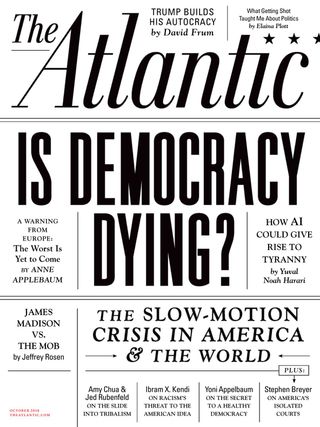
A Warning From Europe
October 2018
|The Atlantic
Polarization. Conspiracy theories. Attacks on the free press. An obsession with loyalty. Recent events in the United States follow a pattern Europeans know all too well.

On December 31, 1999, we threw a party. It was the end of one millennium and the start of a new one; people very much wanted to celebrate, preferably somewhere exotic. Our party fulfilled that criterion. We held it at Chobielin, the manor house in northwest Poland that my husband and his parents had purchased a decade earlier, when it was a mildewed ruin. We had restored the house, very slowly. It was not exactly finished in 1999, but it did have a new roof. It also had a large, freshly painted, and completely unfurnished salon—perfect for a party.
The guests were various: journalist friends from London and Berlin, a few diplomats based in Warsaw, two friends who flew in from New York. But most of them were Poles, friends of ours and colleagues of my husband, who was then a deputy foreign minister in the Polish government. A handful of youngish Polish journalists came too—none then particularly famous—along with a few civil servants and one or two members of the government.
You could have lumped the majority of them, roughly, in the general category of what Poles call the right—the conservatives, the anti-Communists. But at that moment in history, you might also have called most of my guests liberals—free-market liberals, or classical liberals—or maybe Thatcherites. Even those who might have been less de nite about economics certainly believed in democracy, in the rule of law, and in a Poland that was a member of NATO and on its way to joining the European Union—an integrated part of modern Europe. In the 1990s, that was what being “on the right” meant.

هذه القصة من طبعة October 2018 من The Atlantic.
اشترك في Magzter GOLD للوصول إلى آلاف القصص المتميزة المنسقة، وأكثر من 9000 مجلة وصحيفة.
هل أنت مشترك بالفعل؟ تسجيل الدخول
المزيد من القصص من The Atlantic
The Atlantic
You Had to Be There
An emerging field of history asks if we can ever really understand how our forebears experienced love, anger, fear, and sorrow.

23 mins
January 2026

The Atlantic
By the Horns
The week before the biggest bullfight of her career, in Cádiz, Spain, this past July, 24-year-old Miriam Cabas posted a carefully produced video on Instagram.
1 mins
January 2026

The Atlantic
The New German War Machine
After World War II, Germany embraced pacifism as a form of atonement. Now the country is arming itself again.
18 mins
January 2026
The Atlantic
The Eloquence
The prime minister was watching a disaster movie when we found him.
4 mins
January 2026

The Atlantic
What's for Dinner, Mom?
The women who want to change the way America eats
12 mins
January 2026

The Atlantic
How Terror Works
A 1947 German novel explores the sometimes corrosive, sometimes energizing nature of fear.
8 mins
January 2026

The Atlantic
Yesterday's Idea of a Modern Man
Sam Shepard, a self-made cowboy, was also a poet of masculine angst.
7 mins
January 2026

The Atlantic
ACCOMMODATION NATION
America's colleges have an extra-time-on-tests problem.
11 mins
January 2026

The Atlantic
Respect the Drummer
A new history of rock, told through its overlooked heroes
5 mins
January 2026

The Atlantic
THE MOST POWERFUL MAN IN SCIENCE
WHY IS ROBERT F. KENNEDY JR. SO CONVINCED HE'S RIGHT?
42 mins
January 2026
Translate
Change font size