
استمتع بـUnlimited مع Magzter GOLD
احصل على وصول غير محدود إلى أكثر من 9000 مجلة وصحيفة وقصة مميزة مقابل
The Temple Panchang
November 25, 2019
|Outlook
The Ayodhya verdict puts a legal seal on the goal of the rath yatra that led to Babri Masjid’s demolition. What does it mean for the future of the BJP-RSS and of Indian democracy?

It is unlikely that the dust billowing from falling debris, whether in India’s remote past or near history, will ever settle. India lives as if in a constant series of detonations, of making and unmaking, wilfully filling out the idea of an endless cycle of death and rebirth…animated by the (often imagined) memory of past lives. The November 9 Supreme Court verdict on Ayodhya, which cleared the path for temple construction, spoke to different memories in different people. For many, it recalled December 6, 1992— the day that saw enough debris, “an egregious violation”, in the court’s words—and the mobs that exacted their toll before and after. For those moved by the promise of a Ram temple, it recalled another: Somnath. The phoenix among temples, if ever there was one.
Reaching back to Somnath’s historical symbolism was always a deliberate part of the Ayodhya story. It was from there that L.K. Advani, the BJP’s original Hindutva icon, launched his rath yatra in 1990. In his 2008 book My Country My Life, he wrote of Somnath with the tropes appropriate to a Hindutva party’s self-validating narrative—primarily, “the historical lineage of Muslim aggression”. “The intention was to contextualize Ayodhya…and then to seek legitimacy for (the) mandir movement by drawing a parallel,” he wrote. Some of his compeers in the saffron brotherhood are drawing more prosaic parallels too. Especially in the way the temple is proposed to be built and managed. Now that the Supreme Court has mandated temple construction, the next act will be about the who and the how—with more than one aspirant temple authority on the scene. And the other question beyond Ayodhya: what next?
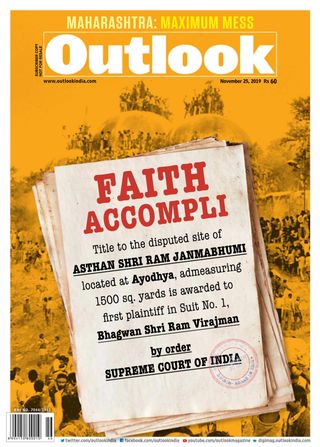

هذه القصة من طبعة November 25, 2019 من Outlook.
اشترك في Magzter GOLD للوصول إلى آلاف القصص المتميزة المنسقة، وأكثر من 9000 مجلة وصحيفة.
هل أنت مشترك بالفعل؟ تسجيل الدخول
المزيد من القصص من Outlook

Outlook
The Big Blind Spot
Caste boundaries still shape social relations in Tamil Nadu-a state long rooted in self-respect politics

8 mins
December 11, 2025

Outlook
Jat Yamla Pagla Deewana
Dharmendra's tenderness revealed itself without any threats to his masculinity. He adapted himself throughout his 65-year-long career as both a product and creature of the times he lived through
5 mins
December 11, 2025

Outlook
Fairytale of a Fallow Land
Hope Bihar can once again be that impossibly noisy village in Phanishwar Nath Renu's Parti Parikatha-divided, yes, but still capable of insisting that rights are not favours and development is more than a slogan shouted from a stage
14 mins
December 11, 2025

Outlook
The Lesser Daughters of the Goddess
The Dravidian movement waged an ideological war against the devadasi system. As former devadasis lead a new wave of resistance, the practice is quietly sustained by caste, poverty, superstition and inherited ritual
2 mins
December 11, 2025

Outlook
The Meaning of Mariadhai
After a hundred years, what has happened to the idea of self-respect in contemporary Tamil society?
5 mins
December 11, 2025

Outlook
When the State is the Killer
The war on drugs continues to be a war on the poor
5 mins
December 11, 2025

Outlook
We Are Intellectuals
A senior law officer argued in the Supreme Court that \"intellectuals\" could be more dangerous than \"ground-level terrorists\"
5 mins
December 11, 2025

Outlook
An Equal Stage
The Dravidian Movement used novels, plays, films and even politics to spread its ideology
12 mins
December 11, 2025
Outlook
The Dignity in Self-Respect
How Periyar and the Self-Respect Movement took shape in Tamil Nadu and why the state has done better than the rest of the country on many social, civil and public parameters
5 mins
December 11, 2025

Outlook
When Sukumaar Met Elakkiya
Self-respect marriage remains a force of socio-political change even a century later
7 mins
December 11, 2025
Translate
Change font size