يحاول ذهب - حر
The JNU difference
January 31, 2020
|FRONTLINE
Jawaharlal Nehru University’s unique admissions policy ensures that students come from all corners of the country, from all socioeconomic backgrounds. The JNU learning experience takes place both inside and outside the classroom, in the debates and discussions that the university is famous for, and in the struggles and agitations that make headlines.

OF THE MANY THOUSANDS OF STUDENTS who have passed through the portals of Jawaharlal Nehru University (JNU) over the past five decades, few would say that the time they spent in JNU did not transform their lives, world view and social attitudes.
Classroom studies in JNU, mostly at the postgraduate level except for fresh entrants to the foreign languages courses, are themselves quite different from those of most other universities. The course content is framed somewhat differently and is taught and tested by most faculty with considerable rigour in a semester system, and in a manner that challenges rote learning and encourages critical thinking. Self-study of texts from the rather extensive reading lists is a must. If a student goes on to do research, s/he is pushed to even more rigorous self-study, and to an interpretive and critical approach towards both academic works and social reality. Teachers, too, interact with students as adults capable of comprehending subjects on their own without the need to be spoon-fed. Essay-type questions in examinations, term papers and seminar presentations, and a well-stocked library, make the JNU learning experience distinctive in India, certainly in the social sciences, humanities, liberal arts, policy and governance, and the distinctive school of international studies with foundational education in international politics, and later specialisation in different regions of the world, in diplomacy, disarmament and international law.
JNU students and alumni would also aver that, however good the curricular side is, much more learning is achieved outside the classroom at this university. At JNU, the process of seeking to critically understand the world around us takes place to a considerable extent in the almost endless debates and discussions that the university is famous for, and in the struggles and agitations which make the most headlines.
NIGHT MEETINGS
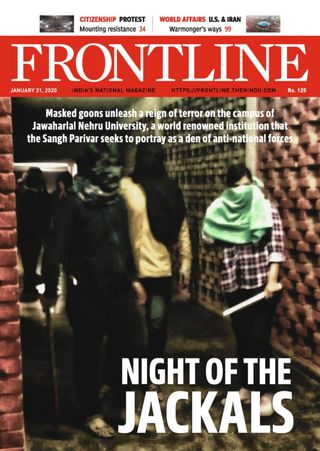

هذه القصة من طبعة January 31, 2020 من FRONTLINE.
اشترك في Magzter GOLD للوصول إلى آلاف القصص المتميزة المنسقة، وأكثر من 9000 مجلة وصحيفة.
هل أنت مشترك بالفعل؟ تسجيل الدخول
المزيد من القصص من FRONTLINE

FRONTLINE
How Not To Handle An Epidemic
The lockdowns were meant to buy time to put in place appropriate health measures and contain the coronavirus’ spread, but they have failed to achieve the objective and heaped immense misery on the marginalised sections of society. India is still in the exponential phase of the COVID-19 infection and community transmission is a reality that the government refuses to accept.

9 mins
June 5, 2020
FRONTLINE
Tragedy on foot
As the COVID-19-induced lockdown cuts the ground beneath their feet in Tamil Nadu, thousands of migrant workers are trudging along the highway to the relative safety of their upcountry homes.
11 mins
June 5, 2020
FRONTLINE
Sarpanchs as game changers
Odisha manages to keep COVID-19 well under control because of the strong participation of panchayati raj institutions and the community at the grass-roots level under the leadership of Chief Minister Naveen Patnaik.
7 mins
June 5, 2020

FRONTLINE
Scapegoating China
As the COVID-19 death rate spikes and the economy tanks in the United States, Donald Trump and his advisers target China and the World Health Organisation with an eye to winning the forthcoming presidential election.
10 mins
June 5, 2020

FRONTLINE
New worries
Kerala’s measured approach to the pandemic and lockdown has yielded results. But it still has to grapple with their huge economic impact on its economy, which it feels the Centre’s special financial relief package does little to alleviate.
9 mins
June 5, 2020
FRONTLINE
No love lost for labour
Taking advantage of the lockdown and the inability of workers to organise protests, many State governments introduce sweeping changes to labour laws to the detriment of workers on the pretext of reviving production and boosting the economy.
8 mins
June 5, 2020
FRONTLINE
Capital's Malthusian moment
In a world that needs substantial reorienting of production and distribution, Indian capital is resorting to a militant form of moribund neoliberalism to overcome its current crisis. In this pursuit of profit, it is ready and willing to throw into mortal peril millions whom it adjudicates as not worth their means—an admixture of social Darwinism born of capital’s avarice and brutalism spawned by Hindutva. .
14 mins
June 5, 2020
FRONTLINE
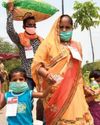
Understanding migration
When governments and their plans are found to be blatantly wanting in addressing reverse migration, exercises such as the Ekta Parishad’s survey of migrant workers throughout India can be useful to work out creative long-lasting solutions.
10 mins
June 5, 2020
FRONTLINE
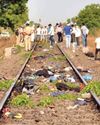
Waiting for Jabalpur moment
The Supreme Court’s role in ensuring executive accountability during the ongoing lockdown leaves much to be desired. Standing in shining contrast is the record of some High Courts.
15 mins
June 5, 2020

FRONTLINE
An empty package
The Modi regime, which has been unable to control the COVID-19 infection, restore economic activity and provide relief to millions exposed to starvation, trains its sights on Indian democracy, making use of the panic generated by fear and a lockdown that forecloses paths of resistance.
17 mins
June 5, 2020
Translate
Change font size