
استمتع بـUnlimited مع Magzter GOLD
احصل على وصول غير محدود إلى أكثر من 9000 مجلة وصحيفة وقصة مميزة مقابل
يحاول ذهب - حر
The How & Why Of Consciousness
December 2023 / January 2024
|Philosophy Now
Raymond Tallis says the mysteries haven't been solved.

Of the many mysteries in which our existence is wrapped, three seem especially resistant to being transformed into soluble problems: why there is something rather than nothing (the origin of stuff); how the material world gave rise to organisms (the origin of living stuff); and how organic life came to be aware of itself and its surroundings (the origin of conscious stuff).
Physicists, who routinely go, even dance, where others fear to tread, sometimes imagine they have an answer to the first mystery. According to Lawrence Krauss in A Universe from Nothing (2012), the universe may have arisen out of nothing in virtue of an instability in the quantum vacuum that somehow delivers a preponderance of stuff over antistuff. This seems closer to creative accounting than a plausible creation story.
As for the second mystery – the emergence of living stuff in a dead world – a succession of theories, and numerous experiments replicating the conditions prevailing when life is thought to have begun, have brought us no closer to a coherent story of the origin of organisms. Yes, we can propose plausible mechanisms as to how molecules associated with life, such as carbohydrates, nucleic acids, and proteins, might have arisen. What is not at all clear is how these could have generated the dialectic between relatively stable structures and the interactions necessary to maintain those structures seen in the most elementary organisms. (For a discussion of this, see my piece ‘The Soup and the Scaffolding’, Philosophy Now, Issue 83.)
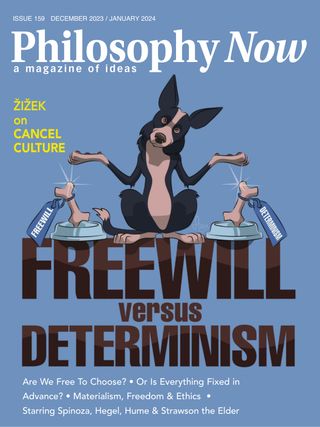

هذه القصة من طبعة December 2023 / January 2024 من Philosophy Now.
اشترك في Magzter GOLD للوصول إلى آلاف القصص المتميزة المنسقة، وأكثر من 9000 مجلة وصحيفة.
هل أنت مشترك بالفعل؟ تسجيل الدخول
المزيد من القصص من Philosophy Now

Philosophy Now
Nosferatu
Stefan Bolea considers two very different artistic approaches to love and death.

6 mins
April/May 2025

Philosophy Now
Heidegger's Ghost
Raymond Tallis wonders where Heidegger's body went when he was philosophising.
7 mins
April/May 2025

Philosophy Now
Is Comedy Good For Us?
Damaris Stock has a laugh with Plato and friends.
10 mins
April/May 2025
Philosophy Now
In Defense of Idleness
Wendell O'Brien says, 'Just Don't Do It'.
10 mins
April/May 2025
Philosophy Now
Leaving Nothing to Chance by Carl Knight
LEAVING NOTHING TO Chance (2025) by Carl Knight, is an informed, proficient and lucid defence of luck egalitarianism.
3 mins
April/May 2025

Philosophy Now
Star Maker by Olaf Stapledon
THE 1937 SCIENCE FICTION novel Star Maker was written by philosophy professor Olaf Stapledon in the dark days as Europe awaited the onslaught of Nazi Germany. This casts a shadow over the whole book.
6 mins
April/May 2025
Philosophy Now
Love & Emptiness in the Sufi Tradition
Medha Ninad Tambe meditates on Rumi, love and self-negation.
7 mins
April/May 2025

Philosophy Now
The Hedgehog's Dilemma: A Metaphor About the Challenges of Human Intimacy
Krishna Chaubey explains Arthur Schopenhauer's poignant thought experiment.
4 mins
April/May 2025
Philosophy Now
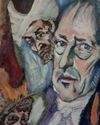
The Mirror & the Flame
Rebwar Fatah imagines Attar's & Hegel's shared path.
4 mins
April/May 2025
Philosophy Now
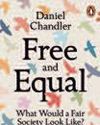
Free and Equal by Daniel Chandler
DANIEL CHANDLER, AN economist and philosopher based at the London School of Economics, begins Free and Equal: What Would a Fair Society Look Like? (2023) by asking an intriguing question. How is it, he wonders, that the most influential political philosopher of the last century has had almost no practical impact on politics or policy? The philosopher in question is John Rawls, whose magnum opus was A Theory of Justice (1971).
5 mins
April/May 2025
Translate
Change font size