
استمتع بـUnlimited مع Magzter GOLD
احصل على وصول غير محدود إلى أكثر من 9000 مجلة وصحيفة وقصة مميزة مقابل
يحاول ذهب - حر
What The Earth Will Look Like When We're Gone?
June 2017
|BBC Knowledge
From asteroid strike to climate change to nuclear war, humanity faces all kinds of existential threats. But, if our species disappeared tomorrow, what would actually happen – and what kind of planet would we be leaving behind,

We are living through the dawn of a new epoch in our planet’s history – the Anthropocene. Humans have always shaped aspects of their environment, from fire to farming. But the influence of Homo sapiens on Earth has reached such a level that it now defines current geological time.
From air pollution in the upper atmosphere to fragments of plastic at the bottom of the ocean, it’s almost impossible to find a place on our planet that humankind has not touched in some way. But there’s a dark cloud on the horizon. Well over 99 per cent of the species that have ever existed on Earth have died out, most during cataclysms of the sort that killed off the dinosaurs.
Humanity has never faced an event of that magnitude, but, sooner or later, we will.
THE END IS NIGH!
Human extinction, many experts believe, is not a matter of ‘if’, but ‘when’. And some think it will come sooner rather than later. In 2010, eminent Australian virologist Frank Fenner claimed that humans will probably be extinct in the next century thanks to overpopulation, environmental destruction and climate change.
Of course, Earth can and will survive just fine without us. Life will persist, and the marks we’ve left on the planet will fade faster than you might think. Our cities will crumble, our fields will overgrow, and our bridges will fall. “Nature will break down everything eventually,” says Alan Weisman, author of the 2007 book The World Without Us, which examines what would happen if humans vanished from the planet. “If it can’t break stuff down, it eventually buries it.”
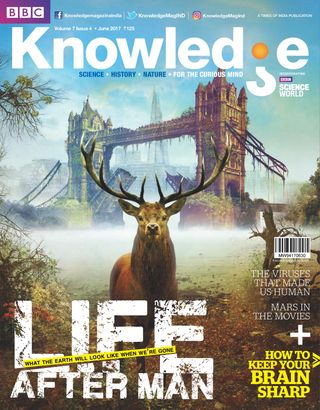

هذه القصة من طبعة June 2017 من BBC Knowledge.
اشترك في Magzter GOLD للوصول إلى آلاف القصص المتميزة المنسقة، وأكثر من 9000 مجلة وصحيفة.
هل أنت مشترك بالفعل؟ تسجيل الدخول
المزيد من القصص من BBC Knowledge

BBC Knowledge
Are We Close To Making Our Home Away From Earth?
Our exploration of the cosmos is hampered by our bodies and minds, which struggle in space. So could we ever overcome our Biology and settle among the stars?

10 mins
August 2017

BBC Knowledge
The Viruses That Made Us Human
Viruses give us infections, from the common cold to Ebola and Aids. But new research shows that they may also have played a key role in shaping the evolution of homo sapiens.
9 mins
June 2017

BBC Knowledge
Can You Supercharge Your Brain?
Your brain is the finely-tuned machine that controls all your actions and emotions, so it makes sense to keep it well-oiled. But, asks Rita Carter, are there any scientifically proven methods to ensure it works better for longer?
7 mins
June 2017

BBC Knowledge
First Self- Balancing Robot
This robot is the Planar Elliptical Runner (PER).
1 min
August 2017

BBC Knowledge
Is Social Media Making You Anti-Social?
Many of us have experienced the ways in which social media has changed the online world. But should we be worried about it altering our behaviour too?
8 mins
August 2017

BBC Knowledge
What You Need To Know Before You Get In A Driverless Car
Autonomous vehicles can take much of the danger out of driving, but they also present us with new problems to solve. So what needs to be figured out before the technology gets the green light?
7 mins
August 2017

BBC Knowledge
Saadat Hasan Manto
Saadat Hasan Manto felt deeply and wrote strongly; his work invigorates and disturbs.
7 mins
August 2017

BBC Knowledge
King Of The Mountains
Picture a primate that grazes like a cow, climbs cliffs like a mountain goat and forms groups as big as shoals of fish. Noah Snyder-Mackler introduces Ethiopia’s gelada.
7 mins
December 2016

BBC Knowledge
Is Technology Changing Our Brains?
We increasingly rely on social media to talk to friends, GPS to navigate and the web for information. But, asks Jo Carlowe, is that wise?
10 mins
February 2017

BBC Knowledge
Are You a Genetic Superhero?
Recent research has revealed a handful of ‘superheroes’ walking among us, whose DNA gifts them with resistance against serious diseases. Now, as Kat Amey observes, just have to find them…
8 mins
February 2017
Translate
Change font size