
استمتع بـUnlimited مع Magzter GOLD
احصل على وصول غير محدود إلى أكثر من 9000 مجلة وصحيفة وقصة مميزة مقابل
يحاول ذهب - حر
Kings Of Cooperation
March/April 2017
|Archaeology
The Olmec city of Tres Zapotes may have owed its longevity to a new form of government.

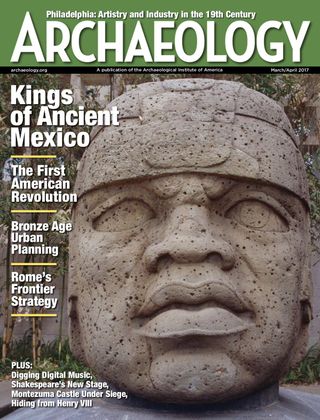
On a sweltering day in 1862 at the foot of the Tuxtla Mountains in the Mexican state of Veracruz, a farm worker was clearing a cornfield when he hit something hard and smooth lodged in the earth. He thought it was the rounded base of an iron cauldron buried upside down, and, it being the 1860s, he reported the find to the owner of the hacienda where he worked. The farmworker’s boss told him to dig up the cauldron immediately and bring it to him. As the farm worker labored to uncover the object, he realized he had found not a large iron bowl, but a gargantuan stone sculpture with a pair of glaring eyes, a broad nose, and a down turned mouth. What had appeared to be the base of a cauldron was actually the top of a helmet worn by the glowering figure. What the farm worker had unearthed was a colossal Olmec head, one of the first clues to the existence of that ancient culture.
Over the next century and a half, archaeologists would uncover many more of these heads along the Mexican Gulf Coast and discover the ancient cities where they were carved. The site of that first fateful discovery became known as Tres Zapotes, after a type of fruit tree common in the area. Along with the sites of San Lorenzo and La Venta, Tres Zapotes was one of the great capitals of the Olmec culture, which emerged by 1200 b.c. as one of the first societies in Mesoamerica organized into a complex social and political hierarchy.


هذه القصة من طبعة March/April 2017 من Archaeology.
اشترك في Magzter GOLD للوصول إلى آلاف القصص المتميزة المنسقة، وأكثر من 9000 مجلة وصحيفة.
هل أنت مشترك بالفعل؟ تسجيل الدخول
المزيد من القصص من Archaeology
Archaeology
THE EGYPTIAN SEQUENCE
Until now, the earliest Egyptians to have even part of their DNA sequenced were three people who lived between 787 and 544 B.C.

1 mins
November/December 2025

Archaeology
SOURCE MATERIAL
As early as 40,000 years ago, some hunter-gatherers in southern Africa ventured long distances to procure special types of stone to make their tools.
1 min
November/December 2025

Archaeology
Secrets of the Seven Wonders
How archaeologists are rediscovering the ancient world's most marvelous monuments
13 mins
November/December 2025
Archaeology
ACTS OF FAITH
Evidence emerges of the day in 1562 when an infamous Spanish cleric tried to destroy Maya religion
12 mins
November/December 2025

Archaeology
OASIS MAKERS OF ARABIA
Researchers are just beginning to understand how people thrived in the desert of Oman some 5,000 years ago
8 mins
November/December 2025

Archaeology
FOSSIL FORCE
One of the planet's most successful arthropods, trilobites, abounded in the oceans from about 520 million to 250 million years ago.
1 min
November/December 2025
Archaeology
BIGHORN MEDICINE WHEEL, WYOMING
Perched almost 9,700 feet above sea level on Medicine Mountain in Wyoming's Bighorn Range, the Medicine Wheel is an 80-foot-diameter circular structure made from limestone boulders.
2 mins
November/December 2025
Archaeology
ANCIENT LOOK BOOK
A young woman buried in China's Tarim Basin some 2,000 years ago went to the afterlife accompanied by the height of fashion.
1 mins
November/December 2025
Archaeology
A FAMILIAR FACE
In the early eleventh century, a landslide on the island of Ostrów Lednicki in western Poland caused a hillfort to collapse and slip to the bottom of Lake Lednica.
1 min
November/December 2025
Archaeology
Temples to Tradition
A looted cache of bronzes compels archaeologists to explore Celtic sanctuaries across Burgundy
13 mins
November/December 2025
Translate
Change font size