
استمتع بـUnlimited مع Magzter GOLD
احصل على وصول غير محدود إلى أكثر من 9000 مجلة وصحيفة وقصة مميزة مقابل
يحاول ذهب - حر
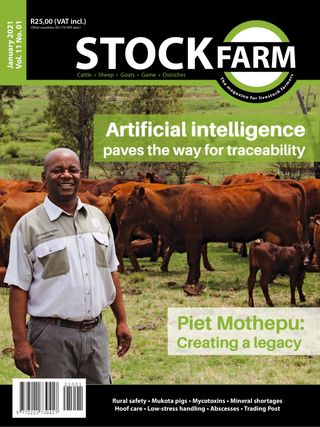
Stringent hygiene protocols can keep abscesses at bay
January 2021
|Stockfarm
Sheep and goat abscesses are not only painful to the animals they affect, but can have a devastating effect on a producer’s pocket.

Two of the most common culprits that cause these unfortunate afflictions are Corynebacterium pseudotuberculosis and Trueperella pyogenes.
C. pseudotuberculosis is a facultative aerobic, gram-positive bacterium that lives in soil. This bacterium is the causative organism of caseous lymphadenitis (CLA) and has been isolated from goats, sheep, horses, cattle, and humans (although to a lesser extent).
T. pyogenes, previously known as Arcanobacterium pyogenes, is a nonmotile, facultative anaerobic, gram-positive bacterium. It is an opportunistic bacterium that can cause a diverse range of diseases such as mastitis, liver abscesses, and pneumonia in cattle, sheep, pigs, and goats.
Spread of the bacteria
Normally, these two types of bacteria infect the more susceptible animals in the herd, with infection spreading further via infected animals. C. pseudotuberculosis infections can occur when certain procedures, such as ear tagging, tail docking or castration are performed using unsterilised tools.
T. pyogenes can infect animals through breaks in the skin barrier caused by wounds from ticks, thorns, grass seeds, and weeds. In sheep in particular, grass seeds are known to penetrate the soft skin around the throat, which can lead to abscesses around the tongue and pharynx.
C. pseudotuberculosis
When infected with C. pseudotuberculosis, it takes between 15 and 140 days for an abscess to develop. The infected animals usually show few clinical signs, but when a large number of abscesses develop, animals will lose weight and become lethargic.

هذه القصة من طبعة January 2021 من Stockfarm.
اشترك في Magzter GOLD للوصول إلى آلاف القصص المتميزة المنسقة، وأكثر من 9000 مجلة وصحيفة.
هل أنت مشترك بالفعل؟ تسجيل الدخول
المزيد من القصص من Stockfarm

Stockfarm
World School Milk Day: A national celebration of dairy
The Department of Basic Education (DBE), in partnership with Milk SA's Consumer Education Project (CEP), marked the national celebration of World School Milk Day (WSMD) at Mandlomsobo Primary School in Bronkhorstspruit on 26 September.

2 mins
January 2026

Stockfarm
A breed that you like will work with you
Data can't fix what selection broke, and your grandpa knew it.
4 mins
January 2026
Stockfarm
2025 Santam Agriculture Silage Competition: Wet conditions, winning silage
Plaas Media's twelfth Santam Agriculture National Silage Competition once again showcased impressive expertise among its participants.
4 mins
January 2026
Stockfarm
Unravelling the regulations for dairy and imitation dairy products
Regulation R1510 of 22 November 2019, which governs dairy and imitation dairy products, recently took centre stage during a webinar hosted by the Dairy Standard Agency (DSA). Thabang Rampa, manager of regulatory affairs at the DSA, provided a technical interpretation of key sections of the regulation, aimed at improving industry's understanding of the prescribed minimum compositional and labelling requirements.
3 mins
January 2026

Stockfarm
2025 ARC National Master Dairyman Awards: Top dairy farmers honoured
The Agricultural Research Council (ARC) announced the winners of its 2025 National Master Dairyman Awards during a ceremony held in November at Lanzerac Estate in Stellenbosch.
2 mins
January 2026
Stockfarm
Abattoirs: The hidden pulse of meat safety
In conversations regarding the meat supply chain, the first and final links tend to take prominence, while the work performed by the middlemen often goes unnoticed. Yet every link plays a vital role. The real question is: Do we truly understand the value each link adds? Or has ‘value addition’ become shorthand for 'price addition, leaving producers and consumers feeling the financial strain?
5 mins
January 2026
Stockfarm
Silage equipment you can't do without
Silage is an invaluable resource on many livestock farms but producing it is not always simple or cheap.
3 mins
January 2026
Stockfarm
The value of a vaccination programme for cattle
Vaccination is essential for any cattle operation, especially given the increasing risk of disease outbreaks. According to Dr Paul Reynolds, a veterinarian at the Warden and Vrede Animal Hospitals, vaccines are never developed arbitrarily. Each exists because a specific disease threat warranted it.
4 mins
January 2026
Stockfarm
Silage competition winners: Key success factors
The Santam Agriculture National Silage Competition once again delivered impressive results, maintaining its high standards and enthusiastic participation. This year’s judging spanned six key categories: nutrient composition, fermentation quality, aerobic stability, top-layer losses, compaction or density, and visual assessment.
2 mins
January 2026
Stockfarm
Why use a silage inoculant?
Producing high-quality silage is critical for any livestock operation, especially in regions where seasonal forage shortages are common. One of the most effective ways to improve silage fermentation and preservation is with a silage inoculant.
2 mins
January 2026
Translate
Change font size