
استمتع بـUnlimited مع Magzter GOLD
احصل على وصول غير محدود إلى أكثر من 9000 مجلة وصحيفة وقصة مميزة مقابل
يحاول ذهب - حر
Low-Stress Cattle Handling: The Basics
October 2020
|Stockfarm
Reducing stress during handling not only improves productivity, but also prevents physiological changes that lower productivity. Handling stress lowers conception rates and reduces immune and rumen function in animals. It is therefore vital for handlers to have a good grasp of livestock behaviour in order to reduce stress and injury, which in turn will lead to increased profit.

Another key aspect that is markedly increasing is the public image of cattle farming. Consumers must have peace of mind that the meat they eat has been produced in a low-stress environment.
The good news is that creating a low-stress environment will cost you virtually nothing. The only cost is the time it takes to learn the ins and outs of cattle behaviour and to then practise the necessary skills.
This is the first of a series of articles in which low-stress cattle handling (LSCH) will be explored. This article looks at three aspects pertaining to LSCH, as explained in an article by two experts, Michigan State University (MSU) extension educator Ben Bartlett, and Janice Swanson, animal science professor at MSU.
According to these experts, “the secret to LSCH is understanding why cattle act the way they do and then using that knowledge to ‘ask’ and not force them to do what you want.” The facilities used on farms must also aid rather than impede the work producers do. However, no matter how well these facilities are designed, it will not compensate for poor handling skills and a lack of cattle behaviour knowledge.
The following is an excerpt from the article.
Why do cattle act like cattle?
Three ingredients control an animal’s actions: anatomy, instinct and experience.
Let’s look at anatomy first. Cattle see the world differently than we do. Because they are prey animals, their eyes are shaped differently and are located on the sides of their heads. A cow can see up to 300 degrees around itself, whereas a human has roughly a 140-degree field of vision. Cow eyes are more rectangular – our eyes are round – and have silted rather than round pupils.
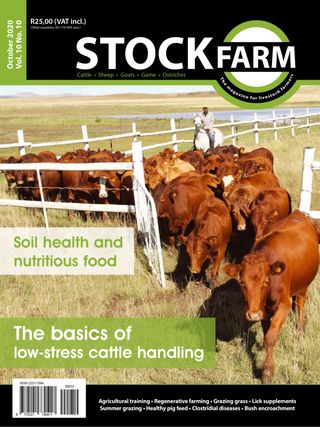

هذه القصة من طبعة October 2020 من Stockfarm.
اشترك في Magzter GOLD للوصول إلى آلاف القصص المتميزة المنسقة، وأكثر من 9000 مجلة وصحيفة.
هل أنت مشترك بالفعل؟ تسجيل الدخول
المزيد من القصص من Stockfarm

Stockfarm
World School Milk Day: A national celebration of dairy
The Department of Basic Education (DBE), in partnership with Milk SA's Consumer Education Project (CEP), marked the national celebration of World School Milk Day (WSMD) at Mandlomsobo Primary School in Bronkhorstspruit on 26 September.

2 mins
January 2026

Stockfarm
A breed that you like will work with you
Data can't fix what selection broke, and your grandpa knew it.
4 mins
January 2026
Stockfarm
2025 Santam Agriculture Silage Competition: Wet conditions, winning silage
Plaas Media's twelfth Santam Agriculture National Silage Competition once again showcased impressive expertise among its participants.
4 mins
January 2026
Stockfarm
Unravelling the regulations for dairy and imitation dairy products
Regulation R1510 of 22 November 2019, which governs dairy and imitation dairy products, recently took centre stage during a webinar hosted by the Dairy Standard Agency (DSA). Thabang Rampa, manager of regulatory affairs at the DSA, provided a technical interpretation of key sections of the regulation, aimed at improving industry's understanding of the prescribed minimum compositional and labelling requirements.
3 mins
January 2026

Stockfarm
2025 ARC National Master Dairyman Awards: Top dairy farmers honoured
The Agricultural Research Council (ARC) announced the winners of its 2025 National Master Dairyman Awards during a ceremony held in November at Lanzerac Estate in Stellenbosch.
2 mins
January 2026
Stockfarm
Abattoirs: The hidden pulse of meat safety
In conversations regarding the meat supply chain, the first and final links tend to take prominence, while the work performed by the middlemen often goes unnoticed. Yet every link plays a vital role. The real question is: Do we truly understand the value each link adds? Or has ‘value addition’ become shorthand for 'price addition, leaving producers and consumers feeling the financial strain?
5 mins
January 2026

Stockfarm
Silage equipment you can't do without
Silage is an invaluable resource on many livestock farms but producing it is not always simple or cheap.
3 mins
January 2026
Stockfarm
The value of a vaccination programme for cattle
Vaccination is essential for any cattle operation, especially given the increasing risk of disease outbreaks. According to Dr Paul Reynolds, a veterinarian at the Warden and Vrede Animal Hospitals, vaccines are never developed arbitrarily. Each exists because a specific disease threat warranted it.
4 mins
January 2026
Stockfarm
Silage competition winners: Key success factors
The Santam Agriculture National Silage Competition once again delivered impressive results, maintaining its high standards and enthusiastic participation. This year’s judging spanned six key categories: nutrient composition, fermentation quality, aerobic stability, top-layer losses, compaction or density, and visual assessment.
2 mins
January 2026
Stockfarm
Why use a silage inoculant?
Producing high-quality silage is critical for any livestock operation, especially in regions where seasonal forage shortages are common. One of the most effective ways to improve silage fermentation and preservation is with a silage inoculant.
2 mins
January 2026
Translate
Change font size