
استمتع بـUnlimited مع Magzter GOLD
احصل على وصول غير محدود إلى أكثر من 9000 مجلة وصحيفة وقصة مميزة مقابل
يحاول ذهب - حر
New Technology To Detect Mycotoxins In Animal Feed
November 13, 2020
|Farmer's Weekly
Prof Cobus Visagie, a mycologist studying fungi at the University of Pretoria’s Forestry and Agricultural Biotechnology Institute, was recently awarded a prestigious research grant under the Future Leaders’ African Independent Research programme. He explains the impact of mycotoxins on humans and animals.

1: According to Prof Cobus Visagie, more work needs to be done on the health impact of mycotoxins on animals.
My research project at the University of Pretoria’s Forestry and Agricultural Biotechnology Institute is titled ‘Ensuring human food and animal feed safety: characterising sources of mycotoxin contamination’. It focuses on identifying which fungi occur on South African crops and animal feed, with the aim of developing new approaches to make their identification more robust, faster and cheaper.
THE STRUGGLE TO FEED THE MILLIONS
World hunger is one of the greatest challenges facing people. One in nine people go to bed hungry and one in three is malnourished. According to pre-COVID-19 statistics, 23% of Africa’s population are undernourished and approximately 45% of child deaths are linked to malnutrition.
In South Africa, even though it is considered one of the most food-secure countries on the continent, 26% of the population suffer from hunger and 28% are at risk of hunger.
According to the UN, the world’s population is expected to reach 9,7 billion by 2050.
Population growth, together with political instability, climate change, pests and diseases (including mycotoxins), limited availability of land, poverty and lack of technology, amongst many other factors, place the UN’s Sustainable Development Goal of zero hunger by 2030 at great risk.
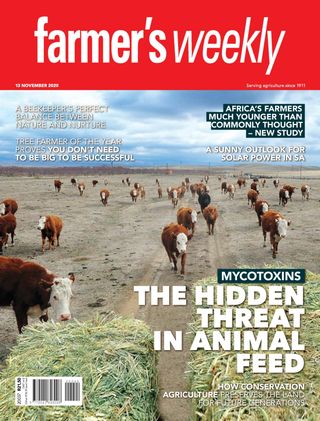

هذه القصة من طبعة November 13, 2020 من Farmer's Weekly.
اشترك في Magzter GOLD للوصول إلى آلاف القصص المتميزة المنسقة، وأكثر من 9000 مجلة وصحيفة.
هل أنت مشترك بالفعل؟ تسجيل الدخول
المزيد من القصص من Farmer's Weekly
Farmer's Weekly
Cash flow budgets: keeping farmers in control of liquidity, risk, and their survival
Profit doesn't guarantee a farm's survival - cash does. Cobus du Plessis explains why cash flow budgets are one of the most important yet underused financial tools on South African farms.

5 mins
February 27 - March 06, 2026

Farmer's Weekly
The toast of the Navy
The incredible story of the World War II-era Great Dane dog Nuisance being enlisted in the Royal Navy is well documented. Graham Jooste shared some entertaining anecdotes involving the canine shipmate.
6 mins
February 27 - March 06, 2026
Farmer's Weekly
Healthier soils deter destructive locusts
Locust swarms remain a serious global threat, capable of devastating crops, livelihoods and local economies across vast regions.
1 min
February 27 - March 06, 2026
Farmer's Weekly
Wheat crisis dominates Grain SA regional meetings
As the ongoing wheat crisis continues to erode producers' margins, emotions ran high at Grain SA's regional meeting in Moorreesburg in the Western Cape.
2 mins
February 27 - March 06, 2026

Farmer's Weekly
A FARMER'S EXPERIENCE
Street Wallet has been a game-changer for Mario Athanasopoulos, hydroponic production consultant and owner of Green City Farms.
1 mins
February 27 - March 06, 2026
Farmer's Weekly
Kesieberg Merino Stud Production Sale
The Kesieberg Merino Stud Production Sale was held on the farm Leeuwfontein on 4 February on behalf of Willie and Herman Henning.
1 min
February 27 - March 06, 2026
Farmer's Weekly
Not cheaper, just different: what you should know about farming in Mozambique
Although Mozambique is often viewed as a cheaper, easier farming location than South Africa, cost comparisons tell a more complex story. But while cross-border production presents real challenges, it also offers opportunities for complementary trade, diversification and regional food security, particularly when it comes to subtropical crops such as bananas.
10 mins
February 27 - March 06, 2026

Farmer's Weekly
The all-rounder anchoring South Africa's beef value chain
Louis Steyl, CEO of the Bonsmara Cattle Breeders' Society of South Africa, spoke to Octavia Avesca Spandiel about how the versatile Bonsmara breed anchors the country's beef value chain, delivering balanced performance, reproductive and feed efficiency, and carcass traits across extensive and intensive systems.
6 mins
February 27 - March 06, 2026

Farmer's Weekly
THE HITCHING POST
I'm a 60-year-old white woman who loves camping, animals, the outdoors, and watching sport.
2 mins
February 27 - March 06, 2026
Farmer's Weekly
Foot-and-mouth disease in pigs
Recently, the radio news mentioned an outbreak of foot-and-mouth disease (FMD) in pigs in South Africa.
2 mins
February 27 - March 06, 2026
Translate
Change font size