يحاول ذهب - حر
Brown locust control: we're getting it wrong
April 22 & 29, 2022 - Double Issue
|Farmer's Weekly
The brown locust is one of the most destructive agricultural pests in South Africa, yet our understanding of its habits and our efforts at controlling it are patchy and haphazard. A paradigm shift is needed, says Dr Johannes Henschel, an ecologist and research associate at the University of the Free State and the National Research Foundation.

Outbreak and recess phases of the brown locust (Locustana pardalina), which is endemic to Southern Africa, have been recorded for more than 200 years, and efforts have been made to control the pest since the founding of the Locust Research Unit of the Agricultural Research Council (ARC) a century ago.
Surprisingly, after a good start to locust research, when careful observations recorded what happens before outbreaks commence, locust research neglected to do much more along these lines. Instead, scientists focused on refining methods of locust control, even though a workshop in the mid1980s had clearly identified that research should concentrate on the functioning of outbreak centres.
No effort has been made to protect crops, although such methods are being developed elsewhere using pheromones (natural substances that are repulsive to locusts but don’t affect human consumers), and ultrasonic acoustic deterrents.
In 2006, although scientists had identified gaps in research that had not been followed through, the ARC’s Locust Research Unit was shut down. Crops are superfoods for locusts, and can augment swarms immensely; leaving croplands unguarded is therefore neglectful, to say the least. However, the actual economic impact of locusts on crops has never been properly quantified; it is simply assumed to be very severe.
INEFFECTIVE CONTROL
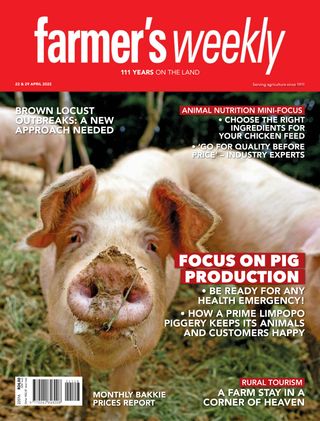

هذه القصة من طبعة April 22 & 29, 2022 - Double Issue من Farmer's Weekly.
اشترك في Magzter GOLD للوصول إلى آلاف القصص المتميزة المنسقة، وأكثر من 9000 مجلة وصحيفة.
هل أنت مشترك بالفعل؟ تسجيل الدخول
المزيد من القصص من Farmer's Weekly
Farmer's Weekly
Cash flow budgets: keeping farmers in control of liquidity, risk, and their survival
Profit doesn't guarantee a farm's survival - cash does. Cobus du Plessis explains why cash flow budgets are one of the most important yet underused financial tools on South African farms.

5 mins
February 27 - March 06, 2026

Farmer's Weekly
The toast of the Navy
The incredible story of the World War II-era Great Dane dog Nuisance being enlisted in the Royal Navy is well documented. Graham Jooste shared some entertaining anecdotes involving the canine shipmate.
6 mins
February 27 - March 06, 2026
Farmer's Weekly
Healthier soils deter destructive locusts
Locust swarms remain a serious global threat, capable of devastating crops, livelihoods and local economies across vast regions.
1 min
February 27 - March 06, 2026
Farmer's Weekly
Wheat crisis dominates Grain SA regional meetings
As the ongoing wheat crisis continues to erode producers' margins, emotions ran high at Grain SA's regional meeting in Moorreesburg in the Western Cape.
2 mins
February 27 - March 06, 2026

Farmer's Weekly
A FARMER'S EXPERIENCE
Street Wallet has been a game-changer for Mario Athanasopoulos, hydroponic production consultant and owner of Green City Farms.
1 mins
February 27 - March 06, 2026
Farmer's Weekly
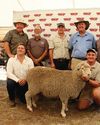
Kesieberg Merino Stud Production Sale
The Kesieberg Merino Stud Production Sale was held on the farm Leeuwfontein on 4 February on behalf of Willie and Herman Henning.
1 min
February 27 - March 06, 2026

Farmer's Weekly
Not cheaper, just different: what you should know about farming in Mozambique
Although Mozambique is often viewed as a cheaper, easier farming location than South Africa, cost comparisons tell a more complex story. But while cross-border production presents real challenges, it also offers opportunities for complementary trade, diversification and regional food security, particularly when it comes to subtropical crops such as bananas.
10 mins
February 27 - March 06, 2026

Farmer's Weekly
The all-rounder anchoring South Africa's beef value chain
Louis Steyl, CEO of the Bonsmara Cattle Breeders' Society of South Africa, spoke to Octavia Avesca Spandiel about how the versatile Bonsmara breed anchors the country's beef value chain, delivering balanced performance, reproductive and feed efficiency, and carcass traits across extensive and intensive systems.
6 mins
February 27 - March 06, 2026

Farmer's Weekly
THE HITCHING POST
I'm a 60-year-old white woman who loves camping, animals, the outdoors, and watching sport.
2 mins
February 27 - March 06, 2026
Farmer's Weekly
Foot-and-mouth disease in pigs
Recently, the radio news mentioned an outbreak of foot-and-mouth disease (FMD) in pigs in South Africa.
2 mins
February 27 - March 06, 2026
Translate
Change font size