يحاول ذهب - حر
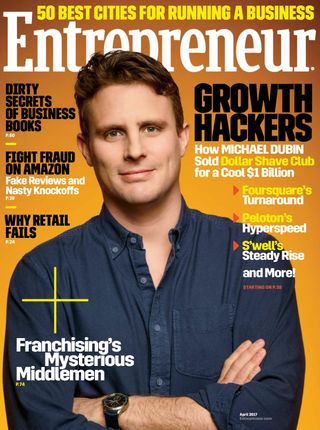
How Michael Dubin Sold Dollar Shave Club For A Cool $1 Billion
April 2017
|Entrepreneur
In five years, Michael Dubin turned a warehouse full of surplus razors into an industry-changing phenomenon. For the first time since selling his company for $1 billion, he talks in detail about how it happened—and why he’s only getting started.

Michael Dubin occasionally allowed himself to envision the moment when everything paid off. He’d be ushered into a grand ceremony, where some conglomerate, eager to own his massively successful company, would offer him a fortune for the pleasure. “I thought we would pass a really nice pen around in a wood-paneled boardroom with portraits of men with white hair,” he says.
When the moment actually came, on July 19, 2016, there was none of that. He was in his pajamas, lying on a bed at the Skytop Lodge in the Pocono Mountains of Pennsylvania. His lawyers had been working through the night, and now the sun was up and Dubin had his cellphone pressed to his ear. In two hours, he was set to take the stage in the hotel’s ballroom, where leaders of the multinational conglomerate Unilever would gather for its biannual conference. There, they’d announce that he was now part of their team: Dollar Shave Club was being acquired for $1 billion. But first, the deal had to be finalized. Dubin listened as, one by one, the executives on the phone gave their approval. Then it came down to him.
Today, Dubin swears he hadn’t been looking to sell the company so early. (He declines to say whether other offers had come along.) The way he saw it, his five-year-old Dollar Shave Club was only getting started. When he launched it in 2012, the razor market was dominated by Gillette, which claimed 72 percent of the U.S. market and had been purchased by Procter & Gamble for $57 billion in 2005. Schick was a distant second. But Dubin saw an opening. He could start by undercutting the big competitors on razors, and then build out something that felt less like a shaving supply company and more like a full-scale men’s club—a subscription-based grooming brand with personality, that men actually identify with.

هذه القصة من طبعة April 2017 من Entrepreneur.
اشترك في Magzter GOLD للوصول إلى آلاف القصص المتميزة المنسقة، وأكثر من 9000 مجلة وصحيفة.
هل أنت مشترك بالفعل؟ تسجيل الدخول
المزيد من القصص من Entrepreneur

Entrepreneur US
Are You Ready for This?
Don't let fear-based thinking hold you back. Here's how to move forward with confidence.

2 mins
Startups - Summer 2026

Entrepreneur US
Reinventing the Flower Shop
French Florist was once a struggling flower shop in Los Angeles. Here's how it transformed into an innovative franchise that's taking on the industry.
3 mins
Startups - Summer 2026
Entrepreneur US
WHAT NEW FRANCHISEES WANT
This survey of 3,500-plus franchisees reveals a lot.
1 min
Startups - Summer 2026

Entrepreneur US
HOTTEST FRANCHISE TRENDS 2026
Here are the 10 hottest trends in the industry, and the 700-plus businesses you can buy in them right now.
1 mins
Startups - Summer 2026

Entrepreneur US
THE BIGGEST SMALLEST BRAND
Lawn Doctor isn't a household name like some other franchise giants. But it has achieved what almost no other brand has.
10 mins
Startups - Summer 2026

Entrepreneur US
These Bagels Are Built to Sell
The food game isn't easy. PopUp Bagels is winning it with creative marketing, maximum efficiency, and a very focused franchisee plan.
3 mins
Startups - Summer 2026

Entrepreneur US
HOW TO BUILD (AND MARKET) A FRANCHISE FOR VERY LITTLE MONEY
Want to turn a tiny hometown business into a franchise with hundreds of locations? The cofounder of L&L Hawaiian Barbecue shares his story—and his secrets.
23 mins
Startups - Summer 2026
Entrepreneur US
3 Ways These Small Businesses Plan for the Future
I Here's how to put the 'success' in your succession plan.
4 mins
May/June 2026

Entrepreneur US
Seilin & Co.
CRAFTSMANSHIP WITH GLOBAL AMBITION
3 mins
May/June 2026

Entrepreneur US
COGIT
BUILT ON INTEGRITY, DRIVEN BY DESIGN
3 mins
May/June 2026
Translate
Change font size