يحاول ذهب - حر
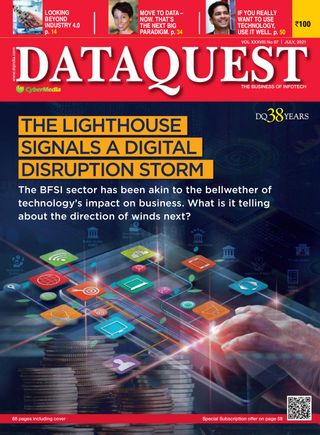
Looking beyond industry 4.0
July 2021
|DataQuest
While Industry 4.0 is already popular in manufacturing, the concept of Society 5.0 offers untapped opportunities in blending technology with society

It’s a busy, sultry Monday morning traffic. In a hurry to reach office, you forget to turn off your room’s AC. You don’t fret, insteadyou reach out for your smartphone, while sitting in your car, and turn the AC off. Also, while browsing through your factory operations app, you receive an alert about machine maintenance for your workshop supervisor and control room. This is a LIVE scenario where the internet of things (IoT), artificial intelligence (AI), machine learning (ML), robotics, and other new-age technologies have become part of our connected world – both at home and in industry – and are now catalysed further, by the pandemic.
Industry 4.0, a decade-old concept, was first introduced by the government in Germany. Today, it has become a regular phenomenon. It entails building ‘intelligent factories’ where machines monitor and take decentralised production and maintenance decisions. This concept has now evolved further to ‘Society 5.0’, which refers to a technology-based human-centered society. Society 5.0 was first conceptualised by Japan and aspires to go beyond industrial transformation and create a ‘Super Smart Society’, where people can resolve various social challenges by incorporating technologies such as IoT, AI/ ML, robotics, and big data into society.
Society 5.0 looks at converging cyberspace (virtual space) and physical space (real space); Japanese companies such as Panasonic and Hitachi, to name a few, is already following this model. Overall, Society 5.0 can be categorised under three broad areas: mobility, home and business.

هذه القصة من طبعة July 2021 من DataQuest.
اشترك في Magzter GOLD للوصول إلى آلاف القصص المتميزة المنسقة، وأكثر من 9000 مجلة وصحيفة.
هل أنت مشترك بالفعل؟ تسجيل الدخول
المزيد من القصص من DataQuest

DataQuest
Engineering India's Al-First Data Centres at Hyperscale
Rohan Sheth explains how AI and HPC are reshaping India's data centres, from density and cooling to power economics, sustainability, and hyperscale decision criteria.

4 mins
February 2026

DataQuest
From copilots to colleagues: Why agentic AI is forcing enterprises to rethink control, trust, and culture
As AI agents shift from assisting to acting, enterprises must redesign governance, data controls, and security guardrails so autonomy stays auditable, reversible, and trusted.
2 mins
February 2026

DataQuest
Reclaiming Control in the AI Era: A Conversation with Kalyan Kumar, CPO, HCLSoftware
Enterprises are reassessing cloud-first strategies as AI becomes core to operations. HCLSoftware's Kalyan Kumar explains why sovereignty, choice and control now shape decisions.
5 mins
February 2026

DataQuest
When infrastructure learns: The rise of the Al-native core
AI-native infrastructure is moving from concept to operational reality, reshaping how organisations build, govern, and scale intelligence across their digital core.
6 mins
February 2026

DataQuest
Bridging the gap between connectivity and compute at scale
As AI scales in India, data centres are evolving into high-density, low-latency platforms that unify connectivity, compute, and sustainability at national scale.
4 mins
February 2026

DataQuest
PUE is not a grapefruit metric, anymore
So what are the new high-hanging fruits for data centre strategists today? And are players going after them?
4 mins
February 2026

DataQuest
Even if Al demand fades, India need not worry - about data centres
For every megawatt (MW) of installed colocation capacity, users here generate approximately 13.2 PB of data monthly- compared to 0.3 PB for Australia and just 0.01 PB for Singapore. India's data centre growth is not dependent on one tech lever. Plus, it is phased and modular and not kneejerk. Manoj Paul explains these contours in detail.
7 mins
February 2026

DataQuest
AI infrastructure and systemic risk
What has been the biggest change in data centre industry-specially after AI workloads? Is Al-bubble a big risk for data centre infra- how much will it affect data centres if something cracks?
1 min
February 2026

DataQuest
Inside the Shift to High-Density, Al-Ready Data Centres
CtrlS' Vipin Jain discusses what it truly takes to build AI-ready data centres in India, balancing high density, liquid-ready cooling, resilience, and ESG accountability.
4 mins
February 2026

DataQuest
Sustainability is now the headline, not a footnote
Sanjay Agrawal, Head Presales and CTO at Hitachi Vantara India and SAARC opines that the conversation is moving beyond headline metrics like PUE toward a broader view of how data lifecycle management and infrastructure efficiency reduce the overall environmental footprint. Let's see why and how- while also touching upon adjacent (or not-so-adjacent) factors like redundancies, availability and AI-readiness
3 mins
February 2026
Translate
Change font size