يحاول ذهب - حر
New Regulations A Headache For Fertiliser Industry
March 1, 2019
|Farmer's Weekly
A proposed new Fertilizer Bill will, if implemented, affect the fertiliser and related industries in several ways, including adding to the administrative burden of the registration of product. Increased regulation may also result in fertiliser cost increases. Theo Boshoff and Ingrid Boshoff outline their concerns.
-

On 12 December 2018, the Department of Agriculture, Forestry and Fisheries (DAFF) received public inputs to the Draft Fertilizer Bill.
The bill will allow DAFF to outsource the functions performed by the registrar of the Fertilizers, Farm Feeds, Agricultural Remedies and Stock Remedies Act No. 36 of 1947 to an assignee of its choice. Some important changes affecting the industry will include the registration of all raw materials, the licensing of all manufacturing facilities, and the storage of raw materials or fertiliser products.
Apart from the increased regulation, the industry will be expected to bankroll all of the costs attached to the introduction of a levy to finance the implementation through assignees. The registration of fertilisers has always been undertaken under Act No. 36 of 1947; considering the magnitude of the amendments DAFF seeks to make, it may have seemed more convenient to simply write a new bill and separate fertilisers as part of its process to rationalise its legislation.
REGULATORY BURDEN
Modern agriculture requires the scientific and precise application of fertilisers to ensure efficiencies in production. However, the environmental risks posed warrant some degree of oversight and regulation. This regulation must be proportionate to the risks involved and the capacity of the regulator to implement oversight effectively. Therein lies the challenge of the proposed legislation.
The new bill introduces an additional regulatory burden. Treating renewals as new registrations increases the cost of doing business and the time taken to receive the necessary documentation.
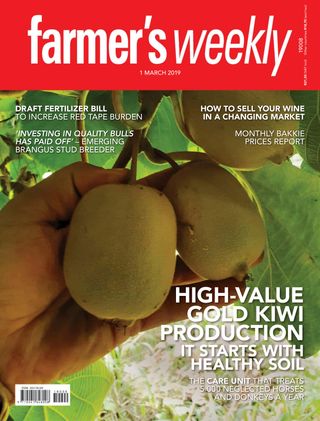

هذه القصة من طبعة March 1, 2019 من Farmer's Weekly.
اشترك في Magzter GOLD للوصول إلى آلاف القصص المتميزة المنسقة، وأكثر من 9000 مجلة وصحيفة.
هل أنت مشترك بالفعل؟ تسجيل الدخول
المزيد من القصص من Farmer's Weekly

Farmer's Weekly
More about growing vegetable seedlings in trays
By considering various factors and tailoring care to specific vegetable needs, you can produce healthy, robust seedlings ready for transplanting into the garden, writes Shane Brody.

2 mins
March 27 - April 3, 2026

Farmer's Weekly
Prodigy of agriculture and land is now a presidential envoy
Wandile Sihlobo will be armed by state powers to accelerate any decision-making that the Presidency deems crucial to grow the sectors of agriculture and land
2 mins
March 27 - April 3, 2026

Farmer's Weekly
Notes from the Western Cape agricultural roadshow
We spent time last week engaging with agribusinesses and farmers in the Western Cape. The primary agricultural focus of the province is various fruits, citrus, table grapes, wine, wheat, barley, livestock, and aquaculture, among many value chains.
3 mins
March 27 - April 3, 2026

Farmer's Weekly
AGOA's promise fades under new US tariffs
Although the African Growth and Opportunity Act has been extended for another year, new US reciprocal tariffs have largely erased its duty-free benefits. Recent modelling shows sharp declines in African exports to the US, particularly in apparel-dependent economies such as Lesotho and Madagascar.
4 mins
March 27 - April 3, 2026

Farmer's Weekly
Egon Zunckel: a lifetime of learning from the soil
The Zunckel name is synonymous with no-till farming in South Africa. Egon Zunckel, a pioneer in the field and a passionate advocate for soil health, shared with Lindi Botha the lessons he has learnt over the years about building resilient soils and sustainable farming systems.
10 mins
March 27 - April 3, 2026
Farmer's Weekly
Researchers explore new tools to combat herbicide resistance
Research by students from Stellenbosch University aimed at combatting herbicide resistance was highlighted during a recent technical trial information day hosted by the Western Cape Department of Agriculture.
6 mins
March 27 - April 3, 2026

Farmer's Weekly
Lepas leaps into South Africa as the latest Chery-owned brand
Lepas has become Chinese carmaker Chery's latest local subbrand with the introduction of the L4 compact SUV. The Citizen's Charl Bosch reports.
2 mins
March 27 - April 3, 2026

Farmer's Weekly
La Rhone Limousins: a small mixed herd turned renowned stud
The Western Cape is not typically known for cattle farming, particularly in its fruit-growing regions. Yet nestled among the orchards below the mountains of Tulbagh is a Limousin stud that has made a name for itself. AJ du Toit of La Rhone Limousins spoke to Henning Naudé about producing high-quality genetics now found on farms in all nine provinces.
6 mins
March 27 - April 3, 2026
Farmer's Weekly
Nitrogen: no easy fix
Products that claim to herald a nitrogen revolution that will boost global food production are nothing more than snake oil, say scientists.
4 mins
March 27 - April 3, 2026

Farmer's Weekly
Potato soup
Rich, creamy, and indulgent, this soup is the ultimate in comfort food.
1 mins
March 27 - April 3, 2026
Translate
Change font size