
Go Unlimited with Magzter GOLD
Get unlimited access to 10,000+ magazines, newspapers and Premium stories for just
Try GOLD - Free
SETTING FENCE POSTS WITH EXPANDING FOAM
Family Handyman
|April - May 2023
Any fence builder knows you need strong posts for a strong fence, and that means backfilling the postholes with a dense, hard material other than dirt.

While a lot can be said for well-draining gravel, the material of choice has long been concrete mix. It's available in 50-lb. bags at any home center, and you usually need two bags per post. For a 100-ft. fence with 10 posts, that means lugging half a ton or more of concrete mix to the site, mixing it with water and shoveling it into the holes.
If a lightweight alternative to concrete performed just as well, many fence builders would choose it just to save their backs. Fence post setting foam offers promise, but is it just as good as concrete?
We asked two experts who set posts with foam: Alex Capozzolo, cofounder of Brotherly Love Real Estate in Philadelphia, and Forrest McCall, co-owner of the home improvement blog "Mama Needs a Project."
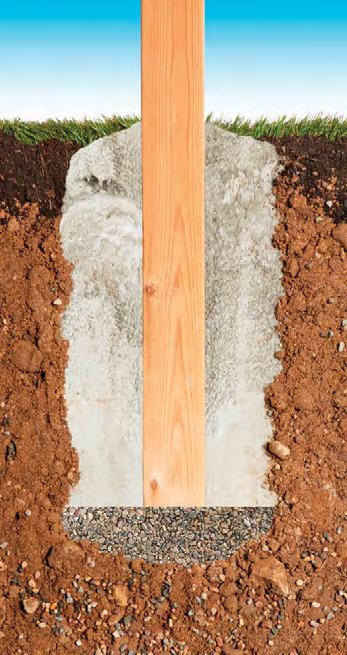
The use of expanding foam to set fence posts is a recent innovation. We asked two experts how foam compares with concrete for strength and usability.
EXPANDING FOAM VS. CONCRETE
Post-setting foam is a two-part product, and before use, the parts must be mixed, which is done right in the bag. It's far lighter than concrete mix. Each bag contains enough material for a single post and weighs only 2 or 3 lbs.
Note: Unlike spray foam in an aerosol can, post-setting foam is a closed-cell formulation without air bubbles, making it more rigid. Most insulating foam is open cell.
BRACING IS KEY
Whether you backfill with concrete or foam, you dig the same size postholes to the same depth, which should be one-third the length of the entire post for stability.


This story is from the April - May 2023 edition of Family Handyman.
Subscribe to Magzter GOLD to access thousands of curated premium stories, and 10,000+ magazines and newspapers.
Already a subscriber? Sign In
MORE STORIES FROM Family Handyman

Family Handyman
DIY Ring Toss
A simple build that blends basic woodworking with classic family fun

2 mins
April / May 2026

Family Handyman
Classic Backyard Game
Easily make your own version of this tailgating and party favorite with just a couple of tools
1 mins
April / May 2026

Family Handyman
Backyard Fireplace
It's surprisingly easy to build-and portable too
3 mins
April / May 2026

Family Handyman
Handy Hints
Try these clever low-effort tricks to make life outside easier—from the garden to the grill
1 mins
April / May 2026

Family Handyman
Smarter Spring Cleaning
From unexpected messes to everyday chores, master home care like a pro with these expert tips and tricks
4 mins
April / May 2026

Family Handyman
Patch Work
Struggling with drywall repairs or installation? Here's how to get smooth results with fewer hassles.
3 mins
April / May 2026

Family Handyman
Mini Dream Home from Scratch
A Family Handyman reader infused Victorian details into a stunning handcrafted playhouse
1 min
April / May 2026

Family Handyman
Tile-Top Coffee Table
Flex your tiling skills with a mixed-material project that brings a pop of color to your home
7 mins
April / May 2026

Family Handyman
Install Ikea Cabinets
Doing the job yourself is easier than you might think-and it can save you thousands
6 mins
April / May 2026

Family Handyman
Master Mulch
Put an extra layer on your garden to retain water, stop erosion and insulate plant roots. Here are some of the most common materials—choose the one with the biggest benefits for your yard.
1 min
April / May 2026
Translate
Change font size