Try GOLD - Free
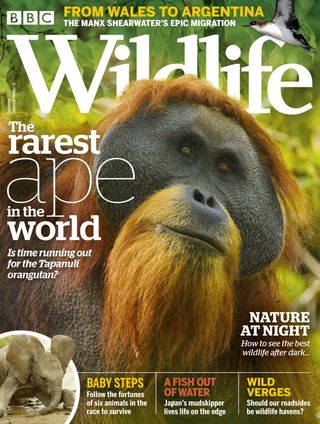
Fish Out Of Water
BBC Wildlife
|September 2019
Patrolling its stretch of mudflats, the territorial mudskipper defends a habitat that’s neither land nor sea.

Life is tough in a halfway world between land and sea, especially for the little fish that inhabit tropical mudflats. Mudskippers have to endure extreme heat and the sticky, salty mud, plus daily flooding and exposure as the tides rise and fall. Not only must they find ways to survive as fish out of water but, to make matters worse, this is a crowded place, filled with rivals to fight and predators to avoid. It’s every walking, jumping fish for itself.
“The big expanses of mud seem monotonous at first,’’ says wildlife photographer Rémi Masson, who has spent hours lying on scorching mudflats on Kyushu Island, in southern Japan, immersing himself in this inhospitable realm. “My biggest surprise was discovering the incredible diversity of species living there. It’s a fascinating spectacle.”
As the water retreats each day, egrets and other wading birds fly in and stalk across the mud searching for prey. Fiddler crabs skitter around and a territorial species of mudskipper, known in Japan as matsugoro, emerge from their borrows in the mud. The fish are a handspan in length and defend a territory 2m across, roughly the area of a pool table. When a crab wanders too close, it receives a stern warning from the resident mudskipper, which raises two blue, spotty fins along its back and opens its big, gaping mouth – a sign that the crab should back off.
Things get more heated when the intruder is another mudskipper. At first, the quarrelling pair put on an intimidating display, dorsal fins raised and mouths open wide. If neither retreat, then a short, sharp skirmish breaks out and the fish leap at each other, wrestling and biting. “The fight scenes are really difficult to photograph,” says Rémi. “They happen very quickly.”

This story is from the September 2019 edition of BBC Wildlife.
Subscribe to Magzter GOLD to access thousands of curated premium stories, and 10,000+ magazines and newspapers.
Already a subscriber? Sign In
MORE STORIES FROM BBC Wildlife
BBC Wildlife
“Our canoe was nearly sunk by a hippo”
Hippos in Niger

3 mins
March 2026

BBC Wildlife
Why does Australia have such weird animals?
AUSTRALIA IS A LONG WAY FROM anywhere and has been for a very long time. The landmass definitively separated from the supercontinent of Gondwana around 40 million years ago and, since then, has existed - as a big blob in the middle of an even bigger ocean - in glorious geographical isolation.
2 mins
March 2026
BBC Wildlife
Which country has the fewest native animals?
AT AROUND 61KM² SAN MARINO, IN Europe, is one of the world's smallest countries. Entirely landlocked, it is surrounded by Italy.
1 min
March 2026

BBC Wildlife
Why do some species sunbathe?
RING-TAILED LEMURS ARE FAMED FOR their 'sun-worshipping' posture, legs and arms outstretched to reveal their pale bellies. Like humans, they do it to save energy and boost health. Sunlight is necessary to many bodily processes. As a source of vitamin D it's required to maintain bone and muscle health. It is also related to the production of serotonin, the chemical that regulates mood, sleep and stress response.
1 mins
March 2026
BBC Wildlife
ALL YOU EVER NEEDED TO KNOW ABOUT THE Piranha
PIRANHAS HAVE A REPUTATION as some of the most dangerous freshwater hunters: terrifying predators capable of devouring a large mammal in mere minutes.
3 mins
March 2026
BBC Wildlife
EAGLES LANDING
Eagle owls were once heavily persecuted. But thanks to a new initiative, these magnificent birds are reclaiming a wetland home
7 mins
March 2026
BBC Wildlife
Do wild guinea pigs exist?
GUINEA PIGS, WHICH ARE NOT pigs and not from Guinea, are domesticated rodents that do not exist in the wild.
1 min
March 2026

BBC Wildlife
SNAP-CHAT: THE INSIDE WORLD OF WILDLIFE PHOTOGRAPHY
Boris Belchev on birds, batteries and battling bears with pop music
3 mins
March 2026
BBC Wildlife
Does anything live in the Bermuda Triangle?
THE BERMUDA TRIANGLE, IN THE NORTH Atlantic Ocean, has become infamous for the planes and ships that are said to have vanished without a trace while travelling through the area.
1 min
March 2026
BBC Wildlife
Do animals have different blood types?
HUMANS HAVE FOUR MAIN BLOOD GROUPS: A, B, AB and O.
1 min
March 2026
Translate
Change font size