
Ga onbeperkt met Magzter GOLD
Krijg onbeperkte toegang tot meer dan 9000 tijdschriften, kranten en Premium-verhalen voor slechts
Poging GOUD - Vrij
The unmatched hybrid vigour of the Boran
Farmer's Weekly
|July 4 - 11, 2025
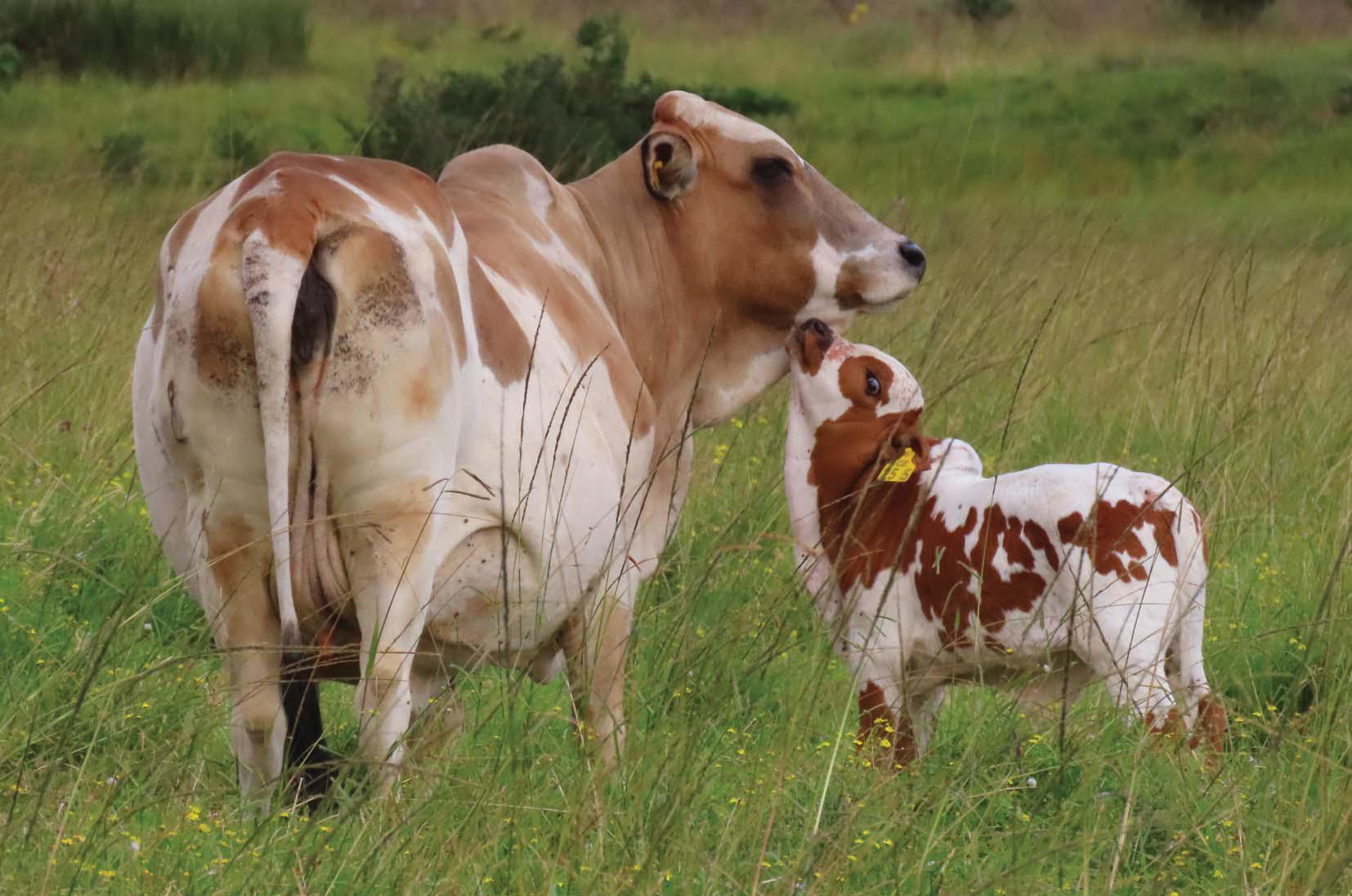
Known as the mother cow of Africa, the Boran has been developed over more than 1 000 years to provide modern farmers with a hardy, cost-effective animal. Sabrina Dean spoke to Gerrit Potgieter from Komga in the Eastern Cape, a council member of the Boran Cattle Breeders' Society of South Africa who oversees the society's marketing portfolio, to find out more about the breed.
-
Tell us more about the history of the Boran.
The Boran has been bred as a purebreed for the past 1 300 years, with its last infusion of ‘new genes’ in 700CE.
This means it isn’t considered a synthetic or compound breed developed over a few decades. The timespan over which the breed has developed also means it has greater hybrid vigour than compound breeds.
It is traced back to cattle domesticated in three parts of the world, some as far back as 8 000BCE. Bos indicus, or Zebu cattle, were domesticated in the Indus Valley (present-day Pakistan) around 4 000BCE. European B. taurus were domesticated in Eastern Europe in 6 000BCE, and African B. taurus were domesticated in the eastern sub-Saharan area around 8 000BCE.
The European B. taurus was derived from a humpless animal, Hamitic Longhorns (B. taurus), which arrived at the Nile Delta around 6 000BCE. Further development came about with the introduction of the Taurine Shorthorn (B. taurus), believed to have happened over a period of about 250 years up to 2 500BCE.
The first introduction of the humped Zebu B. indicus cattle was from roughly 2 000BCE, with the second introduction, associated with the Arab invasion of Africa, about 699CE.
The African B. taurus line was domesticated in sub-Saharan Africa.
Current DNA sampling of the Boran has shown its genetic make-up to be 64% B. indicus, 24% European B. taurus and 12% African B. taurus.
The Boran breed started its development in Eastern Africa, specifically at the Borana Plateau in southern Ethiopia, from where different breeds migrated to various parts of Africa. It developed into the dominant breed of Eastern Africa, particularly Kenya, eventually becoming what was known as the East African Shorthorned Zebu.

Dit verhaal komt uit de July 4 - 11, 2025-editie van Farmer's Weekly.
Abonneer u op Magzter GOLD voor toegang tot duizenden zorgvuldig samengestelde premiumverhalen en meer dan 9000 tijdschriften en kranten.
Bent u al abonnee? Aanmelden
MEER VERHALEN VAN Farmer's Weekly

Farmer's Weekly
Pastry delights and cupcakes
The versatility of pastry in baking and cooking is best flaunted by two vastly different recipes appealing to the sweet and savoury tooth, while a novel way to bake those Christmas-themed cupcakes will also go down well.

4 mins
December 5-12, 2025
Farmer's Weekly
Specialised spider-hunting wasps
Wasps are apex predators of the insect world and have developed many survival strategies. One group of wasps focuses on hunting spiders to provide a source of food for their larval offspring
2 mins
December 5-12, 2025
Farmer's Weekly
From bulls to boardrooms: farming part-time as a professional
Maintaining a farm requires time, resources, and commitment. Farming part-time while being fully employed elsewhere can seem daunting and risky. Although it certainly presents unique challenges, it is feasible for some. Koot Klopper and Herman van Heerden spoke to Henning Naudé about how excellent time management and the delegation of resources, as part-time farmers, successfully keep their farms productive.
5 mins
December 5-12, 2025

Farmer's Weekly
Holy Shiitake: mastering the science of gourmet fungi
Mushroom production is inherently the practice of expanding mycelium. But since wanted and unwanted fungi flourish under the same circumstances, a mushroom farmer's biggest challenge is ensuring the right fungi prevails. Lindi Botha reports on Rory Brooks' learning curve.
9 mins
December 5-12, 2025
Farmer's Weekly
No more 'secret' price hikes?
'Secret' electricity price hikes in South Africa have been curbed in a game-changing court ruling, explains Felix Dube, lecturer in the Department of Law at the University of Venda.
4 mins
December 5-12, 2025
Farmer's Weekly
The cutworm scourge, and how to control it
The dominant cutworm, Agrotis segetum, is causing renewed, costly damage to South African maize, soya bean, and sunflower.
5 mins
December 5-12, 2025
Farmer's Weekly
Legislative gap requires a rethink on biosecurity controls
Since the dawn of democracy, the agriculture sector has cemented its place as one of the essential and trusted pillars for economic growth, job creation, and foreign earnings in South Africa.
2 mins
December 5-12, 2025

Farmer's Weekly
From kitchen experiments to a thriving meat empire
What started as an after-hours kitchen project in the Truter household has grown into the fully fledged meat empire Deli-Co. Brothers Pieter and Hendri Truter told Glenneis Kriel how they turned a local favourite into a multigenerational family business.
7 mins
December 5-12, 2025

Farmer's Weekly
Brushing up on your 'cow speak'
Experienced stockman and cattle judge Willie de Jager spoke to Sabrina Dean about some of the basics of reading cattle behaviour and how best to handle these animals.
8 mins
December 5-12, 2025

Farmer's Weekly
Corporate day job fuels farming dream
Marius Smit lives in the middle of Gauteng in Centurion and spends his workdays in the fast-paced high-stress corporate sector as a group forensic head for Discovery.
5 mins
December 5-12, 2025
Listen
Translate
Change font size