
Gå ubegrenset med Magzter GOLD
Få ubegrenset tilgang til over 9000 magasiner, aviser og premiumhistorier for bare
Prøve GULL - Gratis
Flight fantastic
BBC Wildlife
|July 2023
Summer is the time to see insects on the wing. But how do these diverse and myriad creatures take flight?

THERE IS, ACCORDING TO author Douglas Adams, a knack to flying: throw yourself at the ground and miss. Humans are terrible at flying. We are too big, too heavy, too wingless. Insects, though, thrive in the air, and developing the ability to fly has played a large part in their success. With wings you can escape a predator; move to more advantageous habitats; radiate, diversify and take over the world. The first insect flew at least 325 million years ago, and it quickly caught on. Like the Duke of York's men, once they were up they were up- and for them there was no coming down.
Insect flight manifests itself in many different ways, whether it's the breathtaking control of a dragonfly, the exasperating agility of a house fly, the winsome scattering of a cabbage white, the dogged whirring of a stag beetle or the clumsy bumblings of a daddy long legs.
The principle is simple: four forces - lift, thrust, weight and drag - act on a flying body. Produce enough lift and thrust to counteract the weight and drag, and up you go. Yet the reality is more complex. The conundrum facing any flyer is to combine lightness with strength. Insects solve this by making their wings from the same stuff predominant in their exoskeletons: chitin.
The typical insect wing is a sandwich of this highly effective, lightweight material: two layers squeezed together and interlaced with a network of veins, which serve the dual purpose of strengthening the wing and circulating blood (haemolymph in insects).
SO THAT'S THE LIGHTNESS AND strength taken care of. But to get (and stay) in the air you need a form of propulsion and, as an insect wing contains no muscle, that must come from the body. Insects have evolved two solutions for this. The simpler version is the direct flight mechanism, which is utilised by two orders: Ephemeroptera (mayflies) and Odonata (dragonflies and damselflies), as well as some cockroaches.
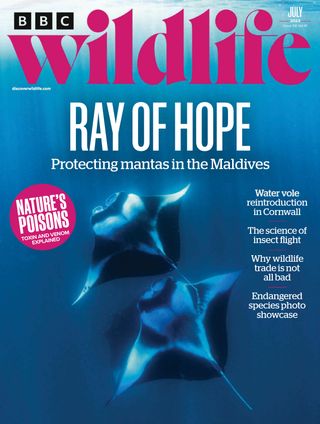

Denne historien er fra July 2023-utgaven av BBC Wildlife.
Abonner på Magzter GOLD for å få tilgang til tusenvis av kuraterte premiumhistorier og over 9000 magasiner og aviser.
Allerede abonnent? Logg på
FLERE HISTORIER FRA BBC Wildlife

BBC Wildlife
SNAP-CHAT
Isaac Szabo talks hellbenders, chub nests and bears on the roof

3 mins
December 2025

BBC Wildlife
Why are the tropics so diverse?
AS YOU MOVE FROM THE POLES towards the equator, species richness increases.
1 mins
December 2025
BBC Wildlife
Magnificent frigatebird
ONE MIGHT BE FORGIVEN FOR thinking that pterodactyls had been de-extincted upon first sighting the silhouette of a magnificent frigatebird.
3 mins
December 2025
BBC Wildlife
YEAR OF THE CAT
Once a phantom of Chile's windswept peaks, this plucky feline is making a comeback
3 mins
December 2025
BBC Wildlife
KATE BRADBURY
“I feel I am part bird at this point at the year's end: I'm ready for spring”
2 mins
December 2025

BBC Wildlife
SNOW DAYS
High in the boreal forests of Colorado, the snowshoe hare lives a secretive life. But one photographer has gained a unique window into its world
3 mins
December 2025
BBC Wildlife
A journey into sound
Progressive hearing loss prompted a memorable quest to absorb nature's calls and choruses
7 mins
December 2025
BBC Wildlife
WILD IN THE CITY
A huge parliament of long-eared owls has made an unlikely home in a Serbian town square
2 mins
December 2025
BBC Wildlife
Birds follow the flames
In the Sierra Nevada of California, fire gives some birds a boost
1 mins
December 2025

BBC Wildlife
Remembering Jane
The ethologist, conservationist and humanitarian Dr Jane Goodall died in October. We reflect on the woman who gave the world hope
5 mins
December 2025
Translate
Change font size