
Gå ubegrenset med Magzter GOLD
Få ubegrenset tilgang til over 9000 magasiner, aviser og premiumhistorier for bare
Prøve GULL - Gratis
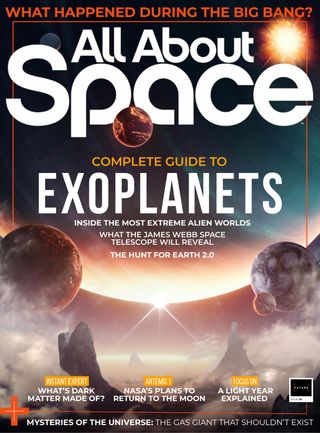
THE BIG BANG THEORY
All About Space
|Issue 126
It’s our best model of how the universe works, but where did it come from?

People have always sought out ‘big-picture’ theories that explain how the universe began, what it looks like on the largest scales and how it evolves over time. In the past, such theories were often based more on human imagination than anything else. But our present best contender, the Big Bang theory, is much better than that. It’s based on a mixture of observational evidence and a mathematical understanding of how space and matter behave on very large scales, and most astronomers believe it probably comes quite close to the truth.
There are two reasons we no longer need to rely on pure imagination to visualise the evolution of the universe. First there’s the fact that we can actually see into the distant past. That’s because light travels at a finite speed, so when a telescope shows us a galaxy a billion light years away, we’re seeing it as it was a billion years ago. The second important factor is the universality of the laws of physics. This means we can study physics in laboratories here on Earth and know that exactly the same principles must apply to the rest of the universe as well.

Putting state-of-the-art observations and some very sophisticated physics together is what’s given us the Big Bang theory. According to this, the universe began approximately 13.8 billion years ago as an infinitesimally tiny point, smaller than the smallest subatomic particle, with an unimaginably high density and temperature. From this minuscule beginning the universe rapidly expanded in size, eventually forming all the stars and galaxies we see today.

Denne historien er fra Issue 126-utgaven av All About Space.
Abonner på Magzter GOLD for å få tilgang til tusenvis av kuraterte premiumhistorier og over 9000 magasiner og aviser.
Allerede abonnent? Logg på
FLERE HISTORIER FRA All About Space
All About Space UK
MYSTERIES OF THE UNI WHERE ARE ALL THE SPIRAL GALAXIES?
There are far fewer spiral galaxies than elliptical ones in the Supergalactic Plane, and scientists are keen to discover why

7 mins
Issue 161
All About Space UK
ZOMBIE STARS
+10 OTHER TERRIFYING SPACE OBJECTS
8 mins
Issue 161

All About Space UK
HOW TO BEAT LIGHT POLLUTION
Thought it was impossible to observe the wonders of the night sky from towns and cities? Think again. Follow our tips and tricks on successfully observing through sky glow
2 mins
Issue 161
All About Space UK
15 STUNNING STAR CLUSTERS
These beautiful stellar groupings are spattered across the cosmos
8 mins
Issue 161
All About Space UK
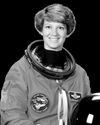
Eileen Collins "It was a difficult mission...we were the first to see Mir"
Having served as both the first female pilot and first female commander of NASA's Space Shuttle, Collins boosted the involvement of women in space exploration to a whole new level
9 mins
Issue 161
All About Space UK
MARS LEAKS FASTER WHEN IT'S CLOSER TO THE SUN
The Red Planet has lost enough water to space to form a global ocean hundreds of kilometres deep
2 mins
Issue 161
All About Space UK
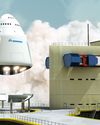
FUTURE TECH KANKOH-MARU
This ambitious reusable spacecraft will be capable of taking 50 people to and from orbit
2 mins
Issue 161
All About Space UK
THE FINAL FRONTIER
Beyond the reach of the Sun is a fascinating region of the cosmos that were only just beginning to explore
8 mins
Issue 161
All About Space UK
A long-lost moon could explain Mars' weird shape and extreme terrain
A long-lost moon could explain why Mars is so different from the other rocky planets in the Solar System. Today Mars has two tiny moons.
2 mins
Issue 161
All About Space UK
A sprinkling of cosmic dust may have helped kick-start life on Earth
Cosmic dust may have helped kick-start life on Earth. New findings challenge a widely held assumption that this wasn't a plausible explanation.
3 mins
Issue 161
Translate
Change font size