
Passez à l'illimité avec Magzter GOLD
Obtenez un accès illimité à plus de 9 000 magazines, journaux et articles Premium pour seulement
Essayer OR - Gratuit
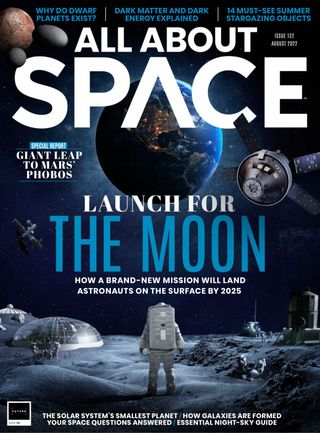
LAUNCH FOR THE MOON
All About Space UK
|Issue 132
NASA's biggest mission in over 50 years will put boots back on the Moon and bring us one step closer to Mars

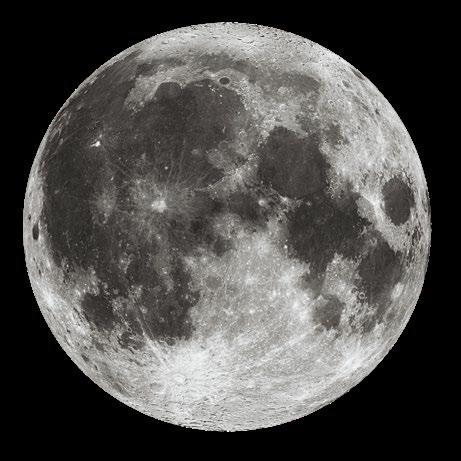
The Moon has captured the attention of humankind for as long as we have gazed upon the stars. Reflecting the Sun's light each dark night, its presence reminds us of worlds beyond our own. But astronauts have done much more than simply look upon it. On 20 July 1969, the first humans landed on the Moon. As part of a series of missions dubbed the Apollo program, NASA astronauts returned to Earth with more knowledge of the rocky orb than our species had ever acquired before. But to think that a handful of missions to this world would make us experts of this foreign terrain would be a mistake. We have only explored a tiny portion of the Moon, and there is still so much more to learn.
It's been half a century since we last visited the Moon, and NASA has made clear its plans to place the next astronauts on its surface by 2025. At least two more people will follow in the few dusty footsteps of the Apollo program's moonwalkers. When the Apollo program was launched, we knew few details about the silvery sphere that graces our skies. Upon the astronauts' successful return to Earth with samples from the Moon, we were able to learn the majority of what we know today about our planet's natural satellite. We learned that the surface of the Moon has a dust covering and the structure contains a core, mantle, and crust just like Earth's. For Apollo, putting humans on the Moon was the main and final goal. It provided us with a better understanding of what was previously an uncharted and unimaginable environment. Soon this territory is to be further explored, and humanity's achievements in space travel will be expanded upon.

Cette histoire est tirée de l'édition Issue 132 de All About Space UK.
Abonnez-vous à Magzter GOLD pour accéder à des milliers d'histoires premium sélectionnées et à plus de 9 000 magazines et journaux.
Déjà abonné ? Se connecter
PLUS D'HISTOIRES DE All About Space UK
All About Space UK
MYSTERIES OF THE UNI WHERE ARE ALL THE SPIRAL GALAXIES?
There are far fewer spiral galaxies than elliptical ones in the Supergalactic Plane, and scientists are keen to discover why

7 mins
Issue 161
All About Space UK
ZOMBIE STARS
+10 OTHER TERRIFYING SPACE OBJECTS
8 mins
Issue 161
All About Space UK
HOW TO BEAT LIGHT POLLUTION
Thought it was impossible to observe the wonders of the night sky from towns and cities? Think again. Follow our tips and tricks on successfully observing through sky glow
2 mins
Issue 161
All About Space UK
15 STUNNING STAR CLUSTERS
These beautiful stellar groupings are spattered across the cosmos
8 mins
Issue 161
All About Space UK
Eileen Collins "It was a difficult mission...we were the first to see Mir"
Having served as both the first female pilot and first female commander of NASA's Space Shuttle, Collins boosted the involvement of women in space exploration to a whole new level
9 mins
Issue 161
All About Space UK
MARS LEAKS FASTER WHEN IT'S CLOSER TO THE SUN
The Red Planet has lost enough water to space to form a global ocean hundreds of kilometres deep
2 mins
Issue 161
All About Space UK
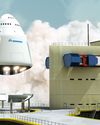
FUTURE TECH KANKOH-MARU
This ambitious reusable spacecraft will be capable of taking 50 people to and from orbit
2 mins
Issue 161
All About Space UK
THE FINAL FRONTIER
Beyond the reach of the Sun is a fascinating region of the cosmos that were only just beginning to explore
8 mins
Issue 161
All About Space UK
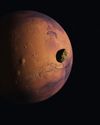
A long-lost moon could explain Mars' weird shape and extreme terrain
A long-lost moon could explain why Mars is so different from the other rocky planets in the Solar System. Today Mars has two tiny moons.
2 mins
Issue 161
All About Space UK
A sprinkling of cosmic dust may have helped kick-start life on Earth
Cosmic dust may have helped kick-start life on Earth. New findings challenge a widely held assumption that this wasn't a plausible explanation.
3 mins
Issue 161
Translate
Change font size