
Passez à l'illimité avec Magzter GOLD
Obtenez un accès illimité à plus de 9 000 magazines, journaux et articles Premium pour seulement
Essayer OR - Gratuit
Leaders' Critical Role in Building a Learning Culture
MIT Sloan Management Review
|Spring 2025
By taking a deliberate, thoughtful role in facilitating learning, leaders can propel change and build employees' problem-solving skills.

Organizational learning and adaptation are vital to business survival and success in the face of disruptive technological advancements, increasing environmental challenges, and rapidly shifting customer demands. Yet many business leaders overlook their critical role in facilitating learning, especially when new initiatives demand it at scale.
During organizational transformations, leaders often delegate the learning component of change management to learning and development specialists inside and outside the company. While this approach can bring teams up to speed with new ways of working in the short term, it occurs outside the context of the work itself in a classroom or workshop setting and doesn't build a capacity for ongoing organizational learning from the work, including the ability to analyze and solve problems from which learning emerges.
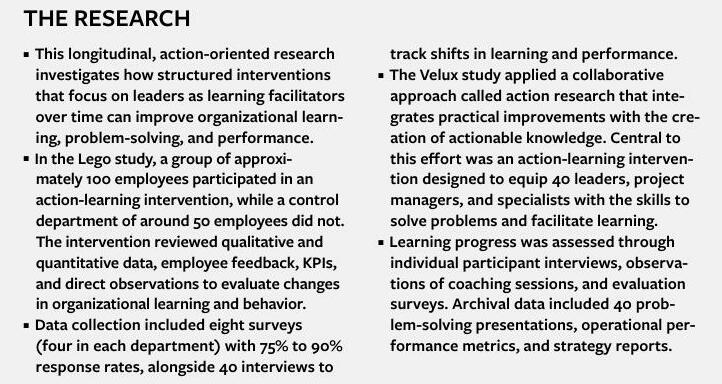 To understand how leaders can become effective learning facilitators, we conducted two longitudinal studies at Lego, a leading toy company, and Velux, a global leader in manufacturing skylights and roof windows.¹ Our research highlights a key insight: To become effective learning facilitators, leaders must embrace the counterintuitive approach of going slow to go fast.² This principle underscores the impact of deliberate, thoughtful leadership in driving lasting change by focusing on building employees' learning and problem-solving skills. At both companies, leaders embraced the role of learning facilitators and actively prioritized the development of employees' systematic problem-solving abilities. By framing each problem as an opportunity for growth, leaders encouraged employees to approach problems with a focus on strengthening long-term skills rather than just resolving the issue at hand.

Cette histoire est tirée de l'édition Spring 2025 de MIT Sloan Management Review.
Abonnez-vous à Magzter GOLD pour accéder à des milliers d'histoires premium sélectionnées et à plus de 9 000 magazines et journaux.
Déjà abonné ? Se connecter
PLUS D'HISTOIRES DE MIT Sloan Management Review

MIT Sloan Management Review
A Smarter Approach to Measuring Customer Experience
Many companies collect more customer experience data points than they need or can use effectively. Here's how to focus on the metrics that matter.

10 mins
Spring 2026

MIT Sloan Management Review
Why Digital Dexterity Is Key to Transformation
To make headway with digital transformation, executives are redefining the challenge: Build a workforce to take advantage of new technologies.
17 mins
Spring 2026

MIT Sloan Management Review
Ask Sanyin: What Makes a 'Listening Tour' Meaningful?
I've just stepped into a new leadership role and was advised to embark on a \"listening tour.\"
2 mins
Spring 2026

MIT Sloan Management Review
Build Business Advantage With Real-Time Decision-Making
Stop running your business on yesterday's data. Real-time data, empowered employees, and agile systems can lead to higher margins.
11 mins
Spring 2026

MIT Sloan Management Review
Balancing Innovation and Risk in the Age of AI
Monica Caldas is executive vice president and global CIO of Liberty Mutual Insurance.
2 mins
Spring 2026

MIT Sloan Management Review
Turn Customer Complaints Into Innovation Blueprints
You can reframe client grievances as an opportunity instead of a burden. At one Swiss hospital, complaints have become a pipeline for improvements to the customer experience.
6 mins
Spring 2026

MIT Sloan Management Review
The Eight Core Principles of Strategic Innovation
A company's future depends on the new directions it explores and develops today — and that requires different structures and capabilities from incremental innovation.
14 mins
Spring 2026

MIT Sloan Management Review
What AI Can Teach Us About Designing Better KPIs
Machine learning research offers four proven strategies to prevent people from gaming measures of organizational performance.
12 mins
Spring 2026

MIT Sloan Management Review
THREE THINGS TO KNOW ABOUT Learning by Hiring
LEADERS WHO RECOGNIZE THAT OUT-siders can be major drivers of innovation often seek to bring new knowledge into their organizations by making external hires.
2 mins
Spring 2026

MIT Sloan Management Review
Validating LLM Output? Prepare to Be ‘Persuasion Bombed’
Research demonstrates how generative AI ramps up the rhetorical pressure on users who question the AI's output.
8 mins
Spring 2026
Listen
Translate
Change font size